

Suicide Does Not Have One Face: Understanding Suicide Risk Across Ages, Identities, and Communities
Suicide does not have one face. It can affect people across ages, races, identities, and socioeconomic backgrounds—even those who appear to be doing well. This National Suicide Prevention Week, we explore suicide risk across communities, barriers to support, and why connection and awareness matter.
During National Suicide Prevention Week, conversations about suicide often focus on recognizing warning signs and encouraging people to seek help. Those conversations are important. However, suicide prevention also requires us to understand something more complicated: there is no single picture of what a person experiencing suicidal thoughts looks like.
Suicide can affect children and teenagers, young adults trying to find their place in the world, parents balancing responsibilities, professionals who appear successful, people experiencing financial hardship, and older adults coping with significant changes and losses. It affects people across racial, ethnic, cultural, socioeconomic, gender, and sexual identities.
In 2024, 48,824 people died by suicide in the United States. During that same year, an estimated 14.3 million adults seriously considered suicide, 4.6 million made a suicide plan, and 2.2 million attempted suicide (Centers for Disease Control and Prevention [CDC], 2026a). These numbers remind us that the people who die by suicide represent only part of a much larger population experiencing significant emotional distress.
Understanding suicide means looking beyond stereotypes and recognizing how individual experiences, relationships, communities, access to resources, and larger social conditions can intersect.
Suicide Risk Is Complex
There is rarely one reason that someone becomes suicidal. Suicide risk can involve a combination of individual, relationship, community, and societal factors (CDC, 2026b).
Mental health conditions, previous suicide attempts, chronic pain, substance use, hopelessness, adverse childhood experiences, relationship loss, bullying, social isolation, financial problems, discrimination, limited access to health care, and other circumstances may contribute to risk. At the same time, having one or even several risk factors does not mean that a person will attempt suicide (CDC, 2026b; National Institute of Mental Health [NIMH], 2025).
This distinction matters. Suicide should not be reduced to a diagnosis, a difficult breakup, financial stress, bullying, or any other single experience. Human beings and their circumstances are more complicated than that.
Children and Adolescents
Young people are navigating a period of enormous emotional, social, and developmental change. School pressures, friendships, bullying, family conflict, identity development, social media, academic expectations, and feelings of belonging can all become part of their emotional world.
Adults can sometimes dismiss changes in a young person's behavior as typical adolescence. While moodiness or a desire for privacy can certainly be developmentally normal, significant or sudden changes deserve attention.
A young person who becomes increasingly isolated, expresses hopelessness, talks about being a burden, experiences dramatic changes in sleeping or eating, takes unusual risks, or begins talking frequently about death may need additional support (NIMH, 2025).
Listening matters. Young people need adults who can tolerate difficult conversations rather than immediately minimizing, lecturing, or trying to fix what they are feeling.
Young Adulthood: When Everyone Expects You to Figure It Out
Young adulthood can look exciting from the outside: college, first jobs, relationships, independence, and new opportunities. It can also involve tremendous uncertainty.
A young adult may be struggling academically, questioning what comes next after graduation, experiencing financial instability, grieving a relationship, feeling lonely after moving away from home, or comparing their life with what they see others achieving.
There can be an enormous gap between how someone's life appears and how it actually feels.
A person may graduate, start a career, post pictures with friends, answer texts, and continue showing up while privately feeling overwhelmed or hopeless. Functioning does not necessarily mean someone is emotionally well.
Middle Adulthood: Carrying the Weight of Responsibility
For adults in midlife, distress can take a different shape.
Someone may simultaneously be managing a career, raising children, caring for aging parents, maintaining relationships, navigating divorce, experiencing health problems, or worrying about finances. Others may be dealing with job loss, loneliness, changing family roles, or the realization that life has not unfolded the way they expected.
Financial or employment problems and relationship loss are among the circumstances associated with suicide risk, particularly when they occur alongside other vulnerabilities (CDC, 2026b; NIMH, 2025).
This is also an age when someone can appear highly functional because other people depend on them.
They may continue going to work.
They may still take their children to school.
They may answer, "I'm fine."
And they may still be struggling.
Older Adults: Loss, Health, Independence, and Connection
Suicide prevention must include older adults.
According to the CDC's most recent national data, adults age 80 and older had the highest suicide rate of any age group in 2024 (CDC, 2026a).
Later adulthood can involve significant transitions: retirement, loss of a spouse or friends, chronic illness or pain, reduced independence, caregiving changes, mobility limitations, and increased isolation.
These experiences should not be dismissed as simply part of getting older. Emotional suffering deserves attention at every stage of life.
Maintaining meaningful relationships, access to quality health and behavioral health care, opportunities for connection, and a sense of purpose can all contribute to well-being.
Race, Ethnicity, and Culture Matter—But Race Is Not a Risk Factor by Itself
Talking about racial disparities in suicide requires care. A person's racial or ethnic identity does not inherently cause suicidal behavior.
Instead, we need to consider the environments in which people live and the experiences they encounter.
Current CDC data demonstrate substantial differences in suicide rates among racial and ethnic populations. In 2024, non-Hispanic American Indian and Alaska Native people and non-Hispanic White people had the highest suicide rates among racial and ethnic groups (CDC, 2026a).
Trends can also change over time. CDC research examining 2018–2023 found that age-adjusted suicide rates increased significantly among Black and Hispanic populations during that period, even while patterns differed considerably by age group (Stone et al., 2025).
Statistics alone, however, cannot explain why disparities exist.
Racism and discrimination, economic hardship, poverty, housing instability, limited educational opportunities, community violence, cultural stigma surrounding mental health, and barriers to physical and mental health care are among the broader conditions that can influence suicide risk and access to support (CDC, 2026c).
Culturally responsive suicide prevention therefore requires more than telling people to "get help." We must also ask whether appropriate, accessible, affordable, and culturally responsive help is actually available to them.
Socioeconomic Status: Money Does Not Make Someone Immune, but Resources Matter
Suicide affects people across income levels. Financial success does not protect someone from depression, grief, relationship problems, loneliness, chronic illness, or suicidal thoughts.
At the same time, socioeconomic conditions matter.
Financial hardship, unemployment, housing instability, and barriers to health care can add substantial stress while simultaneously making support harder to obtain (CDC, 2026b, 2026c).
Research examining U.S. counties has also found lower suicide rates in counties with higher levels of household income, health insurance coverage, and broadband internet access (Cammack et al., 2024).
This does not mean poverty directly causes suicide. It demonstrates why suicide prevention must consider both individual mental health and the conditions surrounding a person's life.
Sometimes telling someone to seek therapy overlooks a very practical question: Can they access it?
LGBTQIA+ Individuals and the Importance of Affirming Environments
LGBTQIA+ people, particularly young people, can experience additional stress related to rejection, bullying, harassment, discrimination, family disapproval, and concerns about safety or belonging.
Importantly, LGBTQIA+ identity itself is not the problem.
The CDC has identified significant mental health and suicide-related disparities among LGBTQ+ youth and notes that stigma, discrimination, harassment, family disapproval, social rejection, and violence contribute to negative health outcomes (CDC, 2024).
This distinction is essential. Prevention means creating environments in families, schools, health care settings, workplaces, and communities where people are treated with dignity and can seek support without fear that an important part of their identity will be judged or treated as something that needs to be changed.
The Person Who "Looks Fine"
Perhaps one of the most important misconceptions about suicide is that we will always be able to see it.
We may expect someone who is suicidal to look visibly depressed, stop functioning, cry frequently, or directly tell us something is wrong.
Sometimes those things happen.
Sometimes they do not.
Someone can laugh with you and still struggle.
Someone can have a successful career and still struggle.
Someone can be a loving parent and still struggle.
Someone can have friends, a home, an education, or financial stability and still struggle.
This is why connection matters.
Warning signs can include talking about wanting to die, feeling hopeless or trapped, believing oneself to be a burden, withdrawing from others, giving away important possessions, significant changes in sleep or eating, increased substance use, extreme mood changes, dangerous risk-taking, or making preparations for death (NIMH, 2025).
Changes that are new, escalating, or significantly different from someone's usual behavior deserve particular attention.
Prevention Is More Than Awareness
Suicide prevention does not require us to have the perfect words.
Sometimes it begins with noticing.
Checking in again when "I'm fine" does not seem convincing.
Listening without immediately trying to solve the problem.
Taking statements about hopelessness or suicide seriously.
Helping someone access appropriate professional or crisis support.
Creating families, schools, workplaces, health care systems, and communities where asking for help is not treated as weakness.
Protective factors identified by the CDC include effective coping and problem-solving skills, reasons for living, supportive relationships, feeling connected to others and one's community, and access to consistent, high-quality physical and behavioral health care (CDC, 2026b).
Suicide prevention is therefore not only about intervening during a crisis. It is also about strengthening connection, reducing barriers to care, recognizing inequities, and creating environments where people feel that their lives and experiences matter.
Suicide Does Not Have One Face
There is no single face of suicide.
It is not limited to one age, race, gender, income level, diagnosis, family structure, or type of person.
And someone's life does not have to look like it is falling apart for their pain to be real.
During National Suicide Prevention Week, we can move beyond simply telling people to "reach out." We can also become people who reach in—who notice changes, ask meaningful questions, listen without judgment, and take emotional pain seriously.
Sometimes the person who needs support looks exactly like the person we assumed was doing just fine.
If you or someone you know is experiencing suicidal thoughts or a mental health crisis, call or text 988 to reach the 988 Suicide & Crisis Lifeline. If there is an immediate life-threatening emergency, call 911 or go to the nearest emergency department.
References
Cammack, A. L., Stevens, M. R., Naumann, R. B., Wang, J., Kaczkowski, W., Valderrama, J., Stone, D. M., & Lee, R. (2024). Vital signs: Suicide rates and selected county-level factors—United States, 2022. Morbidity and Mortality Weekly Report, 73(37), 810–818.
Centers for Disease Control and Prevention. (2024). Health disparities among LGBTQ youth. U.S. Department of Health and Human Services.
Centers for Disease Control and Prevention. (2026a). Suicide data and statistics. National Center for Injury Prevention and Control.
Centers for Disease Control and Prevention. (2026b). Risk and protective factors for suicide. National Center for Injury Prevention and Control.
Centers for Disease Control and Prevention. (2026c). Health disparities in suicide. National Center for Injury Prevention and Control.
National Institute of Mental Health. (2025). Warning signs of suicide. U.S. Department of Health and Human Services.
Stone, D. M., et al. (2025). Notes from the field: Differences in suicide rates, by race and ethnicity and age group—United States, 2018–2023. Morbidity and Mortality Weekly Report, 74.

Growing Up in the In-Between: The Mental Health Impact of Life’s Major Transitions
Growing up comes with major transitions—from starting middle school and graduating high school to leaving college and figuring out adulthood. Explore how life transitions can affect young people and young adults, especially when anxiety, depression, ADHD, and other mental health challenges make change feel even more overwhelming.
Growing up is filled with transitions that we often talk about as exciting milestones: starting middle school, graduating high school, going to college, beginning a career, and becoming an adult.
But there is another side of transitions that does not always get as much attention.
Every new beginning also means leaving something behind.
For young people, transitions can mean leaving familiar routines, friendships, teachers, expectations, identities, and versions of themselves that once felt comfortable. At the same time, they are being asked to adapt to something new—often before they feel completely ready.
That can make even a positive transition emotionally complicated. A young person can be excited about what is coming and still grieve what is ending. They can be proud of themselves and terrified. They can want independence while simultaneously wishing someone would tell them exactly what to do.
And when anxiety, depression, ADHD, or other mental health challenges are already part of the picture, navigating the space between who I was and who I am becoming can feel even more overwhelming.
Elementary School to Middle School: “I’m Not a Little Kid Anymore”
The transition into middle school is often one of the first times children experience a noticeable shift in what the world expects from them.
Suddenly, there may be multiple teachers, changing classrooms, lockers, more homework, increased responsibility, changing friendships, larger peer groups, and greater expectations for organization and independence. At the same time, puberty and significant social and emotional development may be occurring.
Research has identified the transition from primary to secondary education as a potentially stressful developmental period that can affect both psychological well-being and academic functioning (Symonds & Galton, 2014; van Rens et al., 2018).
Adults may see a forgotten assignment and think, You need to be more responsible.
A young person may experience it very differently:
Everyone else seems to know what they are doing. Why can't I figure this out?
This distinction becomes particularly important for children with ADHD, anxiety, depression, or other mental health concerns.
A child with ADHD may understand exactly what needs to be done but struggle with planning, organization, working memory, task initiation, time management, or keeping track of increasingly complex responsibilities.
A child experiencing anxiety may become consumed with questions about friendships, grades, teachers, fitting in, making mistakes, or getting lost.
A child struggling with depression may have difficulty finding the energy, motivation, or concentration necessary to meet new expectations.
What looks like a problem with “maturity” may actually be a young person trying to develop new skills while managing more than adults can see.
Support during this stage does not mean removing every challenge. It means recognizing that independence develops gradually. Young people often need scaffolding before they can successfully manage responsibilities on their own.
High School Graduation: “What Am I Supposed to Do With My Life?”
High school graduation is typically celebrated as an achievement—and it should be.
But graduation can also come with an enormous and sometimes unrealistic question:
What are you doing next?
College? Work? Trade school? Military service? A gap year? Moving away? Staying home?
For some teenagers, the answer feels obvious. For many others, it does not.
At 17 or 18 years old, young people may suddenly feel pressure to make decisions that appear to determine the direction of their entire lives. At the same time, the external structure they have known for most of childhood begins to disappear.
For someone experiencing anxiety, uncertainty about the future can quickly become catastrophic thinking:
What if I choose the wrong school?
What if I don't know what I want to major in?
What if everyone else moves forward and I don't?
What if I disappoint my family?
What if I fail?
Anticipatory anxiety frequently accompanies major life transitions because uncertainty creates room for the mind to imagine possible negative outcomes (Huff, 2025).
Depression can create a different challenge. While everyone else appears excited about graduation, a young person may feel disconnected, unmotivated, overwhelmed, or unable to imagine a future that feels meaningful.
ADHD can add another layer. The transition after high school often requires considerably more self-management. Parents and teachers may no longer be checking assignments, reminding someone where to be, or creating the daily structure that helped keep life moving.
The expectation can quickly shift from follow this structure to create your own structure.
That is a significant developmental leap.
College Graduation and the Unexpected Question: “Now Who Am I?”
College graduation brings another transition that is frequently portrayed as an arrival point.
You graduated. You made it.
Now adulthood begins.
Except adulthood rarely arrives with clear instructions.
The American Psychological Association describes the years roughly between ages 18 and 29 as a period often referred to as emerging adulthood, which can involve identity exploration, instability, changing relationships, increasing independence, and figuring out one's place in work and adult life (Abrams, 2026).
For years, identity may have been attached to being a student.
There were semesters, assignments, breaks, professors, classmates, extracurricular activities, and a relatively predictable calendar.
Then suddenly someone asks:
“So, what are you doing now?”
For a young adult who does not know the answer, that seemingly simple question can carry enormous weight.
The transition out of college can involve job searching, rejection, financial pressure, moving back home, changes in friendships, loss of community, changing family relationships, comparison with peers, and uncertainty about career direction.
It can also bring deeper questions:
Who am I without school?
Do I actually want the career I thought I wanted?
Where do I want to live?
What kind of relationships do I want?
What matters to me?
What if I change my mind?
The transition from college into employment, graduate education, or another stage of adult life can be stressful precisely because it involves both increased responsibility and uncertainty (American Psychological Association, 2010).
For young adults managing anxiety, depression, ADHD, or other mental health concerns, this uncertainty can feel especially heavy.
Mental Health Does Not Pause While You Grow Up
Developmental transitions do not cause every mental health difficulty, and struggling during a transition does not automatically mean someone has a mental health disorder.
However, transitions can expose areas where a person was already struggling or disrupt the routines and supports that previously helped them function.
Someone with ADHD may struggle when external structure disappears.
Someone with anxiety may have difficulty tolerating the uncertainty inherent in change.
Someone experiencing depression may struggle to initiate the very tasks required to build a new routine, career, social network, or sense of direction.
And sometimes several of these experiences overlap.
This is why it is important to look beyond behavior.
A young person who seems “unmotivated” may feel completely overwhelmed.
Someone who repeatedly procrastinates may not know where to begin.
Someone constantly asking a parent what to do may be struggling to trust their own decisions.
Someone who changes majors, career paths, or plans may not be failing to commit—they may be learning more about themselves.
There Is No Perfect Timeline for Becoming Yourself
Perhaps one of the hardest parts of growing up today is how visible everyone else's progress can be.
Social media can make it seem as though everyone else knows exactly what they are doing.
Someone got into their dream college.
Someone landed a great first job.
Someone moved into an apartment.
Someone got engaged.
Someone started graduate school.
Someone appears completely confident.
Meanwhile, you may still be trying to figure out what you want.
But development is not a race, and adulthood is not a checklist.
Emerging adulthood is characterized partly by identity exploration and a feeling of being somewhere between adolescence and full adulthood (Abrams, 2026). Figuring yourself out is not evidence that you are behind. In many ways, figuring yourself out is the work of this stage of life.
Young people need room to experiment, make decisions, reconsider those decisions, make mistakes, develop skills, ask for help, and change their minds.
A middle schooler does not need to have adolescence figured out.
A high school senior does not need to know what they want to do for the rest of their life.
A college graduate does not need to immediately have a career, home, relationships, finances, and identity perfectly established.
Growing up is not one transition.
It is a series of them.
Supporting Young People Through the In-Between
Support during transitions is not about preventing discomfort. Some uncertainty, frustration, and discomfort are natural parts of growth.
Instead, support can mean helping young people build enough stability to tolerate the uncertainty.
That might include maintaining routines where possible, breaking large decisions into smaller ones, creating organizational systems, staying connected to supportive people, normalizing uncertainty, allowing room for changing goals, and recognizing when emotional or behavioral changes are beginning to interfere with everyday functioning.
Therapy can also provide a space for young people to explore questions about identity, independence, relationships, expectations, anxiety, mood, executive functioning, and the future without needing to already know the answers.
Sometimes the most helpful message during a major transition is also one of the simplest:
You do not have to have everything figured out just because something in your life is changing.
You are allowed to grow into what comes next.
References
Abrams, Z. (2026, June 1). How to support young people on the road to adulthood. Monitor on Psychology, 57(4). American Psychological Association.
American Psychological Association. (2010, July 1). Off campus and into the “real world.”
Huff, C. (2025, June 1). Understanding anticipatory anxiety during key life transitions. Monitor on Psychology, 56(4). American Psychological Association.
Symonds, J., & Galton, M. (2014). Moving to the next school at age 10–14 years: An international review of psychological development at school transition. Review of Education, 2(1), 1–27.
van Rens, M., Haelermans, C., Groot, W., & Maassen van den Brink, H. (2018). Facilitating a successful transition to secondary school: (How) does it work? A systematic literature review. Adolescent Research Review, 3, 43–56.

Going to College Is a Transition for the Whole Family
Going to College Is a Transition for the Whole Family
College move-in is often captured in pictures: packed cars, dorm-room decorations, new roommates, smiling parents, and one last photo before someone drives away.
What the pictures don’t always capture is everything happening underneath.
For the student, there may be excitement, fear, relief, homesickness, anticipation, and the sudden realization that this is really happening.
For the parent, there may be enormous pride alongside a quiet ache that is harder to explain.
Going to college is a transition for the student. But sending someone you love to college is a transition, too.
And for returning students and their families, these feelings do not necessarily disappear after freshman year.
For Students: You Can Be Ready and Still Struggle
There is a lot of messaging around college that tells students how they are supposed to feel.
You’re supposed to be excited. You’re supposed to love the independence. You’re supposed to make friends, find your people, enjoy college life, and somehow know how to manage everything on your own.
But becoming more independent does not happen overnight.
College can mean managing academics, meals, laundry, money, appointments, relationships, sleep, roommates, deadlines, social expectations, and your own mental health—often without the familiar structure that existed at home.
Research has shown that the transition to college can involve significant changes in students' routines, relationships, social environments, and psychological well-being (Conley et al., 2014).
Even when you wanted this change, adjusting to it can be hard.
You can be ready to leave home and miss it once you’re gone.
You can make friends and still feel lonely.
You can enjoy your independence and occasionally wish someone else would tell you what to do.
You can have a great day and cry that night.
None of those experiences cancel each other out.
Returning to College Can Be an Adjustment, Too
There is often less attention given to students who are going back to college.
After spending weeks or months at home, returning to campus can mean another major shift in routine.
Suddenly there are roommates again. Classes begin. Deadlines return. Sleep schedules change. Social calendars fill up. Students who became accustomed to home routines may find themselves needing to rebuild structure almost overnight.
Returning students may also be carrying expectations based on previous semesters.
I should know how to do this by now.
But knowing what college is like does not mean every transition back will be easy.
Each semester can bring different classes, relationships, living arrangements, responsibilities, stressors, and versions of yourself.
You are allowed to need time to adjust—even if you have done this before.
For Parents: Your Role Is Changing, Not Disappearing
While students are figuring out independence, parents are often navigating something much quieter.
For years, you may have known where your child was sleeping at night. You knew when they came home, whether they ate dinner, when something seemed wrong, and when they needed help—even when they insisted they didn't.
And then you leave them at college.
You may drive away feeling incredibly proud while simultaneously fighting the urge to turn the car around.
You might walk past their empty bedroom.
Notice how quiet the house feels.
Wonder whether they are eating.
Try not to text again.
Wait for the phone to ring.
This part of parenting can be complicated because the goal has always been to help your child become independent—and then, eventually, they start doing exactly that.
That can feel wonderful.
And painful.
Pride and sadness can exist in the same moment.
Supporting Them Without Solving Everything
One of the challenges for parents during this stage is figuring out when to step in and when to stay nearby.
Your college student may call because they are homesick, overwhelmed by a class, frustrated with a roommate, or convinced that everything is falling apart.
The instinct to fix it can be strong.
But sometimes what they need first is not a solution.
They need somewhere safe to land.
There is a difference between saying, “Here’s what you need to do,” and asking, “What do you think you want to do?”
Young adulthood includes learning that difficult moments can be handled. A bad grade can be addressed. A roommate conflict can be navigated. A professor can be approached. A lonely weekend does not mean college will always feel lonely.
Parents can support that growth without disappearing from it.
Supporting independence does not mean you stop being their safe place. Sometimes it means learning how to be their safe place from a little farther away.
When Home Feels Different, Too
College can also change the relationship between students and parents when everyone comes back together.
A student who has spent months making their own decisions may return home and struggle with old expectations or household rules.
Parents may be surprised when the child who left comes home more independent—or simply different.
This can create tension even in close families.
Both sides may need to renegotiate what the relationship looks like now.
The transition into adulthood is not one moment at age 18. It is a gradual process of figuring out independence, connection, boundaries, responsibility, and how family relationships evolve along the way.
When the Transition Feels Harder Than Expected
Some discomfort is expected during a major life transition. But students and parents should still pay attention when something feels significantly different or continues to worsen.
For students, persistent anxiety or sadness, significant changes in sleep or appetite, isolation, difficulty attending classes or completing responsibilities, or feeling unable to cope may signal that additional support is needed.
Parents may also find themselves struggling more than expected with worry, sadness, changing family dynamics, or uncertainty about their new role.
Getting support does not have to mean that something has gone terribly wrong.
Sometimes support simply gives people somewhere to make sense of a major change while they are living through it.
A New Chapter for Everyone
Eventually, the dorm room gets unpacked.
The parent makes the drive home.
Classes start.
Texts become less frequent.
New routines begin to form.
The unfamiliar slowly becomes familiar.
But adjustment takes time.
Students do not have to have everything figured out on move-in day.
Parents do not have to stop worrying when they drive away.
Students can be excited and homesick.
Parents can be proud and sad.
Both can be ready for what comes next and still miss what came before.
Going to college is not only about leaving home. It is about learning how to carry home, family, independence, and connection with you in a different way.
And maybe that is one of the hardest—and most meaningful—parts of the transition.
References
Conley, C. S., Kirsch, A. C., Dickson, D. A., & Bryant, F. B. (2014). Negotiating the transition to college: Developmental trajectories and gender differences in psychological functioning, cognitive-affective strategies, and social well-being. Emerging Adulthood, 2(3), 195–210. https://doi.org/10.1177/2167696814521808
College move-in is often captured in pictures: packed cars, dorm-room decorations, new roommates, smiling parents, and one last photo before someone drives away.
What the pictures don’t always capture is everything happening underneath.
For the student, there may be excitement, fear, relief, homesickness, anticipation, and the sudden realization that this is really happening.
For the parent, there may be enormous pride alongside a quiet ache that is harder to explain.
Going to college is a transition for the student. But sending someone you love to college is a transition, too.
And for returning students and their families, these feelings do not necessarily disappear after freshman year.
For Students: You Can Be Ready and Still Struggle
There is a lot of messaging around college that tells students how they are supposed to feel.
You’re supposed to be excited. You’re supposed to love the independence. You’re supposed to make friends, find your people, enjoy college life, and somehow know how to manage everything on your own.
But becoming more independent does not happen overnight.
College can mean managing academics, meals, laundry, money, appointments, relationships, sleep, roommates, deadlines, social expectations, and your own mental health—often without the familiar structure that existed at home.
Research has shown that the transition to college can involve significant changes in students' routines, relationships, social environments, and psychological well-being (Conley et al., 2014).
Even when you wanted this change, adjusting to it can be hard.
You can be ready to leave home and miss it once you’re gone.
You can make friends and still feel lonely.
You can enjoy your independence and occasionally wish someone else would tell you what to do.
You can have a great day and cry that night.
None of those experiences cancel each other out.
Returning to College Can Be an Adjustment, Too
There is often less attention given to students who are going back to college.
After spending weeks or months at home, returning to campus can mean another major shift in routine.
Suddenly there are roommates again. Classes begin. Deadlines return. Sleep schedules change. Social calendars fill up. Students who became accustomed to home routines may find themselves needing to rebuild structure almost overnight.
Returning students may also be carrying expectations based on previous semesters.
I should know how to do this by now.
But knowing what college is like does not mean every transition back will be easy.
Each semester can bring different classes, relationships, living arrangements, responsibilities, stressors, and versions of yourself.
You are allowed to need time to adjust—even if you have done this before.
For Parents: Your Role Is Changing, Not Disappearing
While students are figuring out independence, parents are often navigating something much quieter.
For years, you may have known where your child was sleeping at night. You knew when they came home, whether they ate dinner, when something seemed wrong, and when they needed help—even when they insisted they didn't.
And then you leave them at college.
You may drive away feeling incredibly proud while simultaneously fighting the urge to turn the car around.
You might walk past their empty bedroom.
Notice how quiet the house feels.
Wonder whether they are eating.
Try not to text again.
Wait for the phone to ring.
This part of parenting can be complicated because the goal has always been to help your child become independent—and then, eventually, they start doing exactly that.
That can feel wonderful.
And painful.
Pride and sadness can exist in the same moment.
Supporting Them Without Solving Everything
One of the challenges for parents during this stage is figuring out when to step in and when to stay nearby.
Your college student may call because they are homesick, overwhelmed by a class, frustrated with a roommate, or convinced that everything is falling apart.
The instinct to fix it can be strong.
But sometimes what they need first is not a solution.
They need somewhere safe to land.
There is a difference between saying, “Here’s what you need to do,” and asking, “What do you think you want to do?”
Young adulthood includes learning that difficult moments can be handled. A bad grade can be addressed. A roommate conflict can be navigated. A professor can be approached. A lonely weekend does not mean college will always feel lonely.
Parents can support that growth without disappearing from it.
Supporting independence does not mean you stop being their safe place. Sometimes it means learning how to be their safe place from a little farther away.
When Home Feels Different, Too
College can also change the relationship between students and parents when everyone comes back together.
A student who has spent months making their own decisions may return home and struggle with old expectations or household rules.
Parents may be surprised when the child who left comes home more independent—or simply different.
This can create tension even in close families.
Both sides may need to renegotiate what the relationship looks like now.
The transition into adulthood is not one moment at age 18. It is a gradual process of figuring out independence, connection, boundaries, responsibility, and how family relationships evolve along the way.
When the Transition Feels Harder Than Expected
Some discomfort is expected during a major life transition. But students and parents should still pay attention when something feels significantly different or continues to worsen.
For students, persistent anxiety or sadness, significant changes in sleep or appetite, isolation, difficulty attending classes or completing responsibilities, or feeling unable to cope may signal that additional support is needed.
Parents may also find themselves struggling more than expected with worry, sadness, changing family dynamics, or uncertainty about their new role.
Getting support does not have to mean that something has gone terribly wrong.
Sometimes support simply gives people somewhere to make sense of a major change while they are living through it.
A New Chapter for Everyone
Eventually, the dorm room gets unpacked.
The parent makes the drive home.
Classes start.
Texts become less frequent.
New routines begin to form.
The unfamiliar slowly becomes familiar.
But adjustment takes time.
Students do not have to have everything figured out on move-in day.
Parents do not have to stop worrying when they drive away.
Students can be excited and homesick.
Parents can be proud and sad.
Both can be ready for what comes next and still miss what came before.
Going to college is not only about leaving home. It is about learning how to carry home, family, independence, and connection with you in a different way.
And maybe that is one of the hardest—and most meaningful—parts of the transition.
References
Conley, C. S., Kirsch, A. C., Dickson, D. A., & Bryant, F. B. (2014). Negotiating the transition to college: Developmental trajectories and gender differences in psychological functioning, cognitive-affective strategies, and social well-being. Emerging Adulthood, 2(3), 195–210. https://doi.org/10.1177/2167696814521808.

Understanding Adult ADHD: It's More Than Just Trouble Paying Attention
Understanding Adult ADHD: It's More Than Just Trouble Paying Attention
When many people hear the term Attention-Deficit/Hyperactivity Disorder (ADHD), they often picture a child who can't sit still in a classroom, interrupts others, or struggles to pay attention. While these can certainly be signs of ADHD, they represent only part of the story. ADHD is a neurodevelopmental disorder that begins in childhood, but for many people, its effects continue well into adulthood. Some individuals aren't diagnosed until later in life because their symptoms were overlooked, misunderstood, or masked by coping strategies they developed over the years (Centers for Disease Control and Prevention [CDC], 2025).
For many adults, receiving an ADHD diagnosis can bring mixed emotions. Some feel relief because years of confusion finally make sense. Others experience grief as they reflect on missed opportunities or years spent believing they were lazy, unmotivated, or simply "not trying hard enough." Learning more about ADHD can help replace self-criticism with understanding and provide a pathway toward developing strategies that work with—not against—how the brain functions.
ADHD Is More Than Being Distracted
Despite its name, ADHD is not simply a disorder of attention. Rather, it affects the brain's executive functioning—the mental skills that help us plan, organize, prioritize, regulate emotions, manage time, remember information, and complete tasks (American Psychological Association [APA], 2024).
Adults with ADHD don't necessarily lack attention. In fact, many can focus intensely on activities they find interesting, a phenomenon often called hyperfocus. The challenge is regulating attention—shifting focus when needed, sustaining attention on less stimulating tasks, and managing competing demands throughout the day (APA, 2024).
This is one reason ADHD often goes unrecognized in adults. Someone may excel professionally, earn advanced degrees, or appear organized on the outside while privately struggling to keep up with daily responsibilities.
"Why Does Everything Feel So Much Harder for Me?"
Many adults with ADHD describe feeling as though everyone else received an instruction manual for life that they somehow missed.
Maybe you've found yourself thinking:
Why can't I just get started?
Why do simple tasks feel so overwhelming?
Why do I forget things that seem so important?
Why does it feel like I'm constantly playing catch-up?
These experiences are often linked to differences in executive functioning rather than intelligence or motivation (CDC, 2025).
Imagine standing at the bottom of a staircase. You know exactly where you need to go. You understand every step involved. Yet somehow your brain refuses to take the first step. This is how many people describe executive dysfunction. It's not that they don't care. It's not that they don't understand what needs to be done. It's that initiating and organizing the task feels significantly more difficult than others might expect.
Because these struggles are largely invisible, adults with ADHD often internalize negative messages from others—and themselves.
Executive Dysfunction: When Knowing Isn't Enough
Executive functioning acts as the brain's management system. It helps organize thoughts, prioritize tasks, manage time, regulate attention, and carry plans through to completion (APA, 2024).
When executive functioning is impaired, everyday responsibilities can become unexpectedly difficult.
This may look like:
Staring at an email for 30 minutes before responding.
Feeling overwhelmed by a sink full of dishes.
Starting multiple projects but struggling to finish them.
Forgetting appointments despite genuinely intending to remember.
Having difficulty deciding where to begin.
Feeling mentally "stuck," even when you want to be productive.
Have you ever looked at your to-do list and thought, "I know exactly what I need to do…so why can't I start?"
For many adults with ADHD, this experience is frustratingly familiar.
Executive dysfunction isn't about lacking intelligence or motivation. In fact, many adults with ADHD work incredibly hard just to accomplish tasks that others complete with little thought. The effort often goes unseen, contributing to feelings of inadequacy and self-doubt.
Time Blindness: When Time Doesn't Feel Predictable
Have you ever intended to leave the house in "just five more minutes," only to realize 30 minutes had passed?
Or perhaps you've started a project expecting it to take 20 minutes, only to discover you've spent two hours working on it.
Many adults with ADHD experience what's commonly referred to as time blindness—difficulty accurately sensing the passage of time and estimating how long activities will take (APA, 2024).
Time blindness may contribute to:
Frequently running late.
Missing deadlines.
Losing track of time while hyperfocused.
Underestimating how long tasks will take.
Feeling rushed throughout the day.
Difficulty planning ahead.
This isn't because someone with ADHD doesn't value other people's time or lacks responsibility. Rather, their internal sense of time often functions differently, making planning and transitions more challenging.
Understanding time blindness can help replace shame with practical strategies, such as using timers, visual calendars, reminders, and structured routines.
ADHD Isn't Laziness
Perhaps one of the most damaging myths about ADHD is the belief that people simply need to "try harder."
Many adults with ADHD have spent years hearing messages such as:
"If you cared enough, you'd remember."
"You're so smart—you just don't apply yourself."
"Why can't you stay organized?"
Over time, these messages can become deeply internalized. Adults may begin to believe they are lazy, irresponsible, careless, or incapable.
In reality, ADHD has nothing to do with laziness.
Research consistently shows that ADHD affects brain networks involved in attention, motivation, planning, and executive functioning—not intelligence or character (CDC, 2025; APA, 2024). What may look like procrastination from the outside is often a struggle with task initiation. What appears to be disorganization may reflect challenges with working memory and executive functioning.
The difference is important.
Laziness implies a choice not to act.
ADHD often involves wanting to act—but struggling to bridge the gap between intention and action.
That distinction matters because it shifts the conversation from blame to understanding. Instead of asking, "Why can't I just get it together?" a more helpful question becomes, "What support or strategy might help my brain succeed?"
Understanding this difference can be the first step toward developing greater self-compassion. Rather than viewing yourself through the lens of perceived failures, you can begin recognizing the strengths you already possess while learning practical strategies to navigate the challenges ADHD presents.
Emotional Regulation: The Often-Overlooked Part of ADHD
When people think about ADHD, they often think about attention, organization, or hyperactivity. What many don't realize is that ADHD can also affect how people experience and regulate emotions.
Adults with ADHD may feel emotions more intensely and have greater difficulty shifting away from them once they arise (American Psychological Association [APA], 2024). This doesn't mean someone with ADHD is "too emotional." Rather, the brain may have more difficulty regulating emotional responses, making frustration, disappointment, excitement, or sadness feel bigger and last longer.
This may look like:
Becoming overwhelmed more quickly during stressful situations.
Feeling frustrated over small setbacks.
Difficulty calming down after an argument.
Feeling deeply hurt by criticism.
Experiencing emotions that seem to shift rapidly.
For some individuals, this emotional intensity contributes to what is commonly referred to as Rejection Sensitive Dysphoria (RSD)—an intense emotional response to perceived rejection or criticism. While many adults with ADHD identify with this experience, it's important to note that RSD is not currently recognized as an official diagnostic criterion for ADHD in the Diagnostic and Statistical Manual of Mental Disorders (DSM-5-TR). However, clinicians and researchers continue to explore its relationship to ADHD because many individuals report these experiences (APA, 2024).
These emotional experiences are real and can significantly impact relationships, work, and self-esteem. Understanding that emotional regulation difficulties may be part of ADHD—not a personal weakness—can help individuals approach these challenges with greater self-compassion.
ADHD Burnout: When Working Twice as Hard Becomes Exhausting
Many adults with ADHD become experts at hiding their struggles.
They set dozens of reminders.
They stay up late catching up on work.
They overprepare for meetings.
They rely on anxiety to stay productive.
They constantly worry about forgetting something.
From the outside, they may appear successful, organized, and high functioning.
Inside, they often feel exhausted.
This ongoing effort to compensate for ADHD symptoms can lead to ADHD burnout—a state of physical, mental, and emotional exhaustion that develops after prolonged periods of masking symptoms and overcompensating for executive functioning challenges (Knouse, 2023).
Burnout may include:
Feeling mentally drained
Increased anxiety
Difficulty concentrating
Lower motivation
Greater emotional sensitivity
Feeling like everyday responsibilities have become impossible
Many adults describe reaching a point where the strategies that once helped them "hold everything together" simply stop working.
Recognizing burnout is important because it often signals that more sustainable supports and strategies are needed—not that someone has failed.
Masking: The Hidden Work No One Sees
One reason ADHD is often missed in adults is because many people become exceptionally skilled at masking their symptoms.
Masking refers to consciously or unconsciously hiding difficulties in order to meet expectations or avoid criticism.
Someone might:
Triple-check every calendar appointment.
Arrive extremely early because they're afraid of being late.
Spend hours organizing before guests arrive.
Avoid tasks until the last possible minute, then complete them under intense pressure.
Watch how others organize themselves and imitate those systems.
These strategies may help someone appear organized and successful, but they often come at a significant emotional cost.
Masking requires tremendous mental energy.
Over time, it can contribute to chronic stress, anxiety, perfectionism, and burnout.
Because others don't see the internal effort, adults with ADHD may hear comments like, "But you seem to have everything together."
What others don't see are the countless systems, reminders, lists, alarms, sticky notes, and mental energy required just to stay afloat.
Why ADHD Often Looks Different in Women
Although ADHD affects people of all genders, women have historically been underdiagnosed or diagnosed later in life.
For many years, ADHD research focused primarily on young boys who displayed hyperactive and disruptive behaviors. As a result, many girls whose symptoms looked different were overlooked (Knouse, 2023).
Women are often more likely to experience:
Internal restlessness instead of physical hyperactivity.
Daydreaming or appearing "spacey."
Perfectionism.
Anxiety.
Chronic overwhelm.
People-pleasing.
Emotional exhaustion from masking symptoms.
Many women become highly skilled at compensating. They work longer hours, overprepare, create elaborate organizational systems, or push themselves to unrealistic standards.
Because these strategies may hide their struggles, they often don't receive an ADHD diagnosis until adulthood—sometimes after one of their own children is diagnosed.
For many women, receiving a diagnosis later in life can be both validating and emotional. It often helps explain years of wondering why everyday tasks seemed more difficult despite being intelligent, capable, and hardworking.
How Therapy Can Help
While medication is an effective treatment option for many individuals with ADHD, therapy can also play an important role in helping adults better understand their symptoms and develop practical strategies for everyday life (CDC, 2025).
Therapy isn't about changing who you are or eliminating every ADHD-related challenge. Instead, it focuses on understanding how ADHD affects your unique experiences while building tools that support your strengths.
Depending on your needs, therapy may help you:
Develop realistic organizational systems.
Improve time management.
Strengthen executive functioning skills.
Build routines that are flexible and sustainable.
Learn emotional regulation strategies.
Reduce shame and self-criticism.
Improve communication in relationships.
Address anxiety, depression, or stress that may occur alongside ADHD.
Increase self-compassion and confidence.
For many adults, one of the most meaningful parts of therapy is simply realizing they are not alone.
Learning that there is a reason certain tasks have always felt harder—and that effective strategies exist—can be incredibly empowering.
Rather than continuing to ask, "What's wrong with me?" therapy can help shift the question toward, "What works best for the way my brain functions?"
Final Thoughts
If you've spent years believing you were lazy, disorganized, forgetful, or simply "bad at adulting," you're not alone.
Many adults with ADHD have heard these messages for much of their lives. Over time, those messages can become deeply rooted, shaping how they view themselves and their abilities.
But ADHD is not a reflection of your intelligence, your work ethic, or your worth.
It's a neurodevelopmental condition that affects how the brain manages attention, executive functioning, time, and emotions.
Understanding ADHD doesn't erase the challenges—but it can change how you respond to them.
With greater awareness, evidence-based strategies, and the right support, many adults learn to work with their brains instead of constantly feeling like they're fighting against them.
If you recognize yourself in these experiences, know that support is available. Whether you're newly diagnosed, questioning whether ADHD may be part of your story, or simply looking for ways to better understand yourself, seeking information and reaching out for help are meaningful first steps.
Understanding your brain isn't about finding excuses.
It's about finding understanding.
References
American Psychological Association. (2024). Speaking of Psychology: Adult ADHD (Podcast). https://www.apa.org/news/podcasts/speaking-of-psychology/adult-adhd
Centers for Disease Control and Prevention. (2025). ADHD in adults. https://www.cdc.gov/adhd/about/adhd-in-adults.html
Knouse, L. E. (2023). Adult attention-deficit/hyperactivity disorder: A comprehensive review. Psychiatry and Clinical Neurosciences. https://pmc.ncbi.nlm.nih.gov/articles/PMC10205222/
When many people hear the term Attention-Deficit/Hyperactivity Disorder (ADHD), they often picture a child who can't sit still in a classroom, interrupts others, or struggles to pay attention. While these can certainly be signs of ADHD, they represent only part of the story. ADHD is a neurodevelopmental disorder that begins in childhood, but for many people, its effects continue well into adulthood. Some individuals aren't diagnosed until later in life because their symptoms were overlooked, misunderstood, or masked by coping strategies they developed over the years (Centers for Disease Control and Prevention [CDC], 2025).
For many adults, receiving an ADHD diagnosis can bring mixed emotions. Some feel relief because years of confusion finally make sense. Others experience grief as they reflect on missed opportunities or years spent believing they were lazy, unmotivated, or simply "not trying hard enough." Learning more about ADHD can help replace self-criticism with understanding and provide a pathway toward developing strategies that work with—not against—how the brain functions.
ADHD Is More Than Being Distracted
Despite its name, ADHD is not simply a disorder of attention. Rather, it affects the brain's executive functioning—the mental skills that help us plan, organize, prioritize, regulate emotions, manage time, remember information, and complete tasks (American Psychological Association [APA], 2024).
Adults with ADHD don't necessarily lack attention. In fact, many can focus intensely on activities they find interesting, a phenomenon often called hyperfocus. The challenge is regulating attention—shifting focus when needed, sustaining attention on less stimulating tasks, and managing competing demands throughout the day (APA, 2024).
This is one reason ADHD often goes unrecognized in adults. Someone may excel professionally, earn advanced degrees, or appear organized on the outside while privately struggling to keep up with daily responsibilities.
"Why Does Everything Feel So Much Harder for Me?"
Many adults with ADHD describe feeling as though everyone else received an instruction manual for life that they somehow missed.
Maybe you've found yourself thinking:
Why can't I just get started?
Why do simple tasks feel so overwhelming?
Why do I forget things that seem so important?
Why does it feel like I'm constantly playing catch-up?
These experiences are often linked to differences in executive functioning rather than intelligence or motivation (CDC, 2025).
Imagine standing at the bottom of a staircase. You know exactly where you need to go. You understand every step involved. Yet somehow your brain refuses to take the first step. This is how many people describe executive dysfunction. It's not that they don't care. It's not that they don't understand what needs to be done. It's that initiating and organizing the task feels significantly more difficult than others might expect.
Because these struggles are largely invisible, adults with ADHD often internalize negative messages from others—and themselves.
Executive Dysfunction: When Knowing Isn't Enough
Executive functioning acts as the brain's management system. It helps organize thoughts, prioritize tasks, manage time, regulate attention, and carry plans through to completion (APA, 2024).
When executive functioning is impaired, everyday responsibilities can become unexpectedly difficult.
This may look like:
Staring at an email for 30 minutes before responding.
Feeling overwhelmed by a sink full of dishes.
Starting multiple projects but struggling to finish them.
Forgetting appointments despite genuinely intending to remember.
Having difficulty deciding where to begin.
Feeling mentally "stuck," even when you want to be productive.
Have you ever looked at your to-do list and thought, "I know exactly what I need to do…so why can't I start?"
For many adults with ADHD, this experience is frustratingly familiar.
Executive dysfunction isn't about lacking intelligence or motivation. In fact, many adults with ADHD work incredibly hard just to accomplish tasks that others complete with little thought. The effort often goes unseen, contributing to feelings of inadequacy and self-doubt.
Time Blindness: When Time Doesn't Feel Predictable
Have you ever intended to leave the house in "just five more minutes," only to realize 30 minutes had passed?
Or perhaps you've started a project expecting it to take 20 minutes, only to discover you've spent two hours working on it.
Many adults with ADHD experience what's commonly referred to as time blindness—difficulty accurately sensing the passage of time and estimating how long activities will take (APA, 2024).
Time blindness may contribute to:
Frequently running late.
Missing deadlines.
Losing track of time while hyperfocused.
Underestimating how long tasks will take.
Feeling rushed throughout the day.
Difficulty planning ahead.
This isn't because someone with ADHD doesn't value other people's time or lacks responsibility. Rather, their internal sense of time often functions differently, making planning and transitions more challenging.
Understanding time blindness can help replace shame with practical strategies, such as using timers, visual calendars, reminders, and structured routines.
ADHD Isn't Laziness
Perhaps one of the most damaging myths about ADHD is the belief that people simply need to "try harder."
Many adults with ADHD have spent years hearing messages such as:
"If you cared enough, you'd remember."
"You're so smart—you just don't apply yourself."
"Why can't you stay organized?"
Over time, these messages can become deeply internalized. Adults may begin to believe they are lazy, irresponsible, careless, or incapable.
In reality, ADHD has nothing to do with laziness.
Research consistently shows that ADHD affects brain networks involved in attention, motivation, planning, and executive functioning—not intelligence or character (CDC, 2025; APA, 2024). What may look like procrastination from the outside is often a struggle with task initiation. What appears to be disorganization may reflect challenges with working memory and executive functioning.
The difference is important.
Laziness implies a choice not to act.
ADHD often involves wanting to act—but struggling to bridge the gap between intention and action.
That distinction matters because it shifts the conversation from blame to understanding. Instead of asking, "Why can't I just get it together?" a more helpful question becomes, "What support or strategy might help my brain succeed?"
Understanding this difference can be the first step toward developing greater self-compassion. Rather than viewing yourself through the lens of perceived failures, you can begin recognizing the strengths you already possess while learning practical strategies to navigate the challenges ADHD presents.
Emotional Regulation: The Often-Overlooked Part of ADHD
When people think about ADHD, they often think about attention, organization, or hyperactivity. What many don't realize is that ADHD can also affect how people experience and regulate emotions.
Adults with ADHD may feel emotions more intensely and have greater difficulty shifting away from them once they arise (American Psychological Association [APA], 2024). This doesn't mean someone with ADHD is "too emotional." Rather, the brain may have more difficulty regulating emotional responses, making frustration, disappointment, excitement, or sadness feel bigger and last longer.
This may look like:
Becoming overwhelmed more quickly during stressful situations.
Feeling frustrated over small setbacks.
Difficulty calming down after an argument.
Feeling deeply hurt by criticism.
Experiencing emotions that seem to shift rapidly.
For some individuals, this emotional intensity contributes to what is commonly referred to as Rejection Sensitive Dysphoria (RSD)—an intense emotional response to perceived rejection or criticism. While many adults with ADHD identify with this experience, it's important to note that RSD is not currently recognized as an official diagnostic criterion for ADHD in the Diagnostic and Statistical Manual of Mental Disorders (DSM-5-TR). However, clinicians and researchers continue to explore its relationship to ADHD because many individuals report these experiences (APA, 2024).
These emotional experiences are real and can significantly impact relationships, work, and self-esteem. Understanding that emotional regulation difficulties may be part of ADHD—not a personal weakness—can help individuals approach these challenges with greater self-compassion.
ADHD Burnout: When Working Twice as Hard Becomes Exhausting
Many adults with ADHD become experts at hiding their struggles.
They set dozens of reminders.
They stay up late catching up on work.
They overprepare for meetings.
They rely on anxiety to stay productive.
They constantly worry about forgetting something.
From the outside, they may appear successful, organized, and high functioning.
Inside, they often feel exhausted.
This ongoing effort to compensate for ADHD symptoms can lead to ADHD burnout—a state of physical, mental, and emotional exhaustion that develops after prolonged periods of masking symptoms and overcompensating for executive functioning challenges (Knouse, 2023).
Burnout may include:
Feeling mentally drained
Increased anxiety
Difficulty concentrating
Lower motivation
Greater emotional sensitivity
Feeling like everyday responsibilities have become impossible
Many adults describe reaching a point where the strategies that once helped them "hold everything together" simply stop working.
Recognizing burnout is important because it often signals that more sustainable supports and strategies are needed—not that someone has failed.
Masking: The Hidden Work No One Sees
One reason ADHD is often missed in adults is because many people become exceptionally skilled at masking their symptoms.
Masking refers to consciously or unconsciously hiding difficulties in order to meet expectations or avoid criticism.
Someone might:
Triple-check every calendar appointment.
Arrive extremely early because they're afraid of being late.
Spend hours organizing before guests arrive.
Avoid tasks until the last possible minute, then complete them under intense pressure.
Watch how others organize themselves and imitate those systems.
These strategies may help someone appear organized and successful, but they often come at a significant emotional cost.
Masking requires tremendous mental energy.
Over time, it can contribute to chronic stress, anxiety, perfectionism, and burnout.
Because others don't see the internal effort, adults with ADHD may hear comments like, "But you seem to have everything together."
What others don't see are the countless systems, reminders, lists, alarms, sticky notes, and mental energy required just to stay afloat.
Why ADHD Often Looks Different in Women
Although ADHD affects people of all genders, women have historically been underdiagnosed or diagnosed later in life.
For many years, ADHD research focused primarily on young boys who displayed hyperactive and disruptive behaviors. As a result, many girls whose symptoms looked different were overlooked (Knouse, 2023).
Women are often more likely to experience:
Internal restlessness instead of physical hyperactivity.
Daydreaming or appearing "spacey."
Perfectionism.
Anxiety.
Chronic overwhelm.
People-pleasing.
Emotional exhaustion from masking symptoms.
Many women become highly skilled at compensating. They work longer hours, overprepare, create elaborate organizational systems, or push themselves to unrealistic standards.
Because these strategies may hide their struggles, they often don't receive an ADHD diagnosis until adulthood—sometimes after one of their own children is diagnosed.
For many women, receiving a diagnosis later in life can be both validating and emotional. It often helps explain years of wondering why everyday tasks seemed more difficult despite being intelligent, capable, and hardworking.
How Therapy Can Help
While medication is an effective treatment option for many individuals with ADHD, therapy can also play an important role in helping adults better understand their symptoms and develop practical strategies for everyday life (CDC, 2025).
Therapy isn't about changing who you are or eliminating every ADHD-related challenge. Instead, it focuses on understanding how ADHD affects your unique experiences while building tools that support your strengths.
Depending on your needs, therapy may help you:
Develop realistic organizational systems.
Improve time management.
Strengthen executive functioning skills.
Build routines that are flexible and sustainable.
Learn emotional regulation strategies.
Reduce shame and self-criticism.
Improve communication in relationships.
Address anxiety, depression, or stress that may occur alongside ADHD.
Increase self-compassion and confidence.
For many adults, one of the most meaningful parts of therapy is simply realizing they are not alone.
Learning that there is a reason certain tasks have always felt harder—and that effective strategies exist—can be incredibly empowering.
Rather than continuing to ask, "What's wrong with me?" therapy can help shift the question toward, "What works best for the way my brain functions?"
Final Thoughts
If you've spent years believing you were lazy, disorganized, forgetful, or simply "bad at adulting," you're not alone.
Many adults with ADHD have heard these messages for much of their lives. Over time, those messages can become deeply rooted, shaping how they view themselves and their abilities.
But ADHD is not a reflection of your intelligence, your work ethic, or your worth.
It's a neurodevelopmental condition that affects how the brain manages attention, executive functioning, time, and emotions.
Understanding ADHD doesn't erase the challenges—but it can change how you respond to them.
With greater awareness, evidence-based strategies, and the right support, many adults learn to work with their brains instead of constantly feeling like they're fighting against them.
If you recognize yourself in these experiences, know that support is available. Whether you're newly diagnosed, questioning whether ADHD may be part of your story, or simply looking for ways to better understand yourself, seeking information and reaching out for help are meaningful first steps.
Understanding your brain isn't about finding excuses.
It's about finding understanding.
References
American Psychological Association. (2024). Speaking of Psychology: Adult ADHD (Podcast). https://www.apa.org/news/podcasts/speaking-of-psychology/adult-adhd.
Centers for Disease Control and Prevention. (2025). ADHD in adults. https://www.cdc.gov/adhd/about/adhd-in-adults.html.
Knouse, L. E. (2023). Adult attention-deficit/hyperactivity disorder: A comprehensive review. Psychiatry and Clinical Neurosciences. https://pmc.ncbi.nlm.nih.gov/articles/PMC10205222/.

When Sunshine Doesn’t Feel So Bright: Understanding Summertime Seasonal Affective Disorder
When Sunshine Doesn’t Feel So Bright: Understanding Summertime Seasonal Affective Disorder
When most people hear the words Seasonal Affective Disorder, they immediately think of winter: cold temperatures, shorter days, less sunlight, and the emotional slump that can sometimes come with the season.
But what happens when summer is the season that feels difficult?
Although Seasonal Affective Disorder (SAD) is more commonly associated with fall and winter, some people experience a seasonal pattern of depression that begins during the spring or summer. Sometimes referred to as summer-pattern SAD or "reverse SAD," this form of seasonal depression is less common, but the symptoms and their impact on daily life can be very real (Cleveland Clinic, 2022; Shidhore et al., 2024).
For someone struggling during the summer, there can also be an added layer of confusion or guilt. Summer is often portrayed as the season when we are supposed to feel good. The sun is shining. Vacations are happening. Kids are out of school. Social media is filled with beach trips, family adventures, smiling faces, and seemingly endless summer fun.
So, why don't you feel happier?
What Does Summertime SAD Look Like?
Seasonal Affective Disorder involves episodes of depression that follow a recurring seasonal pattern. For people with summer-pattern SAD, symptoms may emerge as spring turns into summer and improve when the seasons change.
Summer-pattern SAD may also look somewhat different from the symptoms people typically associate with winter-pattern SAD. Symptoms can include difficulty sleeping, decreased appetite, anxiety, irritability, agitation or restlessness. As with other forms of depression, people may also experience low energy, sadness or hopelessness, difficulty concentrating, and a loss of interest in activities they usually enjoy (Cleveland Clinic, 2022; UCLA Health, n.d.).
Not everyone experiences seasonal depression in the same way. What matters is noticing when changes in your mood, sleep, appetite, energy, or ability to function begin to form a pattern—particularly if you notice similar changes around the same time each year.
Why Can Summer Feel So Difficult?
There isn't one simple explanation for summertime depression. Seasonal changes can affect our bodies, sleep, routines, social lives, and everyday environments.
Longer daylight hours and hot temperatures may interfere with sleep and daily rhythms for some people. Summer can also mean significant changes in routine: children are home from school, vacations interrupt regular schedules, work patterns may change, and bedtimes often become less consistent. Cleveland Clinic also notes that summer can bring social pressures and a feeling of being out of sync with the people around you when everyone else appears to be enjoying the season (Cleveland Clinic, 2026).
Then there's the pressure to have the "perfect" summer.
You may feel like you should be traveling.
You should be outside.
You should be spending time with friends.
You should be making memories with your family.
You should be enjoying yourself.
When your internal experience doesn't match what summer is "supposed" to look like, it can be easy to wonder why you're struggling. Social media can amplify that feeling when your everyday reality is constantly compared with someone else's vacation photos, beach days, relationships, or seemingly perfect family moments.
But mental health doesn't follow a calendar.
You can appreciate a beautiful sunny day and still feel depressed. You can be on vacation and still experience anxiety. You can love your family and still feel overwhelmed by having everyone home for the summer.
Both things can be true.
Is It Summertime SAD—or Just a Difficult Summer?
Not every period of sadness, anxiety, or stress during the summer means that someone has Seasonal Affective Disorder. Depression and anxiety can occur during any season, and summer itself can introduce stressors that affect mental health without necessarily indicating a seasonal depressive pattern.
That's why paying attention to patterns can be helpful.
Consider how your mood changes throughout the year. Are you sleeping differently? Has your appetite changed? Are you more irritable, anxious, or restless? Do you find yourself withdrawing from people or activities you normally enjoy? Does maintaining your usual routine suddenly feel harder?
Keeping track of changes in your mood, sleep, appetite, and daily functioning over time may help you recognize patterns that aren't always obvious from one day to the next. Research and clinical literature on summer-pattern SAD continue to emphasize that seasonal depression can occur outside the more familiar winter presentation, even though summer-pattern cases are less commonly recognized (Shidhore et al., 2024).
If you're concerned about changes in your mental health, a qualified mental health or medical professional can help determine what may be contributing to your symptoms.
You Don't Have to Wait for Summer to End
If summer is difficult for you, you don't have to minimize what you're experiencing simply because the weather is beautiful.
Therapy can provide a space to explore what's happening beneath the surface. Maybe your routines have changed in ways that leave you feeling ungrounded. Maybe disrupted sleep is affecting your mood. Maybe social expectations are emotionally exhausting. Or perhaps summer brings up loneliness, body-image concerns, financial stress, parenting pressure, or difficult family dynamics that aren't visible to the people around you.
Understanding your experience matters.
If you've noticed that your mental health consistently changes during the spring or summer—or you simply haven't been feeling like yourself—it may be worth paying attention to what your mind and body are telling you.
The sunshine outside doesn't determine how you're supposed to feel inside.
And sometimes, recognizing that you're struggling is the first step toward understanding what you need.
References
Cleveland Clinic. (2022). Seasonal depression (seasonal affective disorder). Cleveland Clinic
Cleveland Clinic. (2026, April 1). Why summer depression happens—and how to cope. Cleveland Clinic Health Essentials
Shidhore, N., et al. (2024). Sunshine and sadness: A case report on summer season seasonal affective disorder. PubMed Central
UCLA Health. (n.d.). Seasonal affective disorder can hit in the summer. UCLA Health
Array Behavioral Care. (n.d.). The ins and outs of reverse seasonal affective disorder. Array Behavioral Care
When most people hear the words Seasonal Affective Disorder, they immediately think of winter: cold temperatures, shorter days, less sunlight, and the emotional slump that can sometimes come with the season.
But what happens when summer is the season that feels difficult?
Although Seasonal Affective Disorder (SAD) is more commonly associated with fall and winter, some people experience a seasonal pattern of depression that begins during the spring or summer. Sometimes referred to as summer-pattern SAD or "reverse SAD," this form of seasonal depression is less common, but the symptoms and their impact on daily life can be very real (Cleveland Clinic, 2022; Shidhore et al., 2024).
For someone struggling during the summer, there can also be an added layer of confusion or guilt. Summer is often portrayed as the season when we are supposed to feel good. The sun is shining. Vacations are happening. Kids are out of school. Social media is filled with beach trips, family adventures, smiling faces, and seemingly endless summer fun.
So, why don't you feel happier?
What Does Summertime SAD Look Like?
Seasonal Affective Disorder involves episodes of depression that follow a recurring seasonal pattern. For people with summer-pattern SAD, symptoms may emerge as spring turns into summer and improve when the seasons change.
Summer-pattern SAD may also look somewhat different from the symptoms people typically associate with winter-pattern SAD. Symptoms can include difficulty sleeping, decreased appetite, anxiety, irritability, agitation or restlessness. As with other forms of depression, people may also experience low energy, sadness or hopelessness, difficulty concentrating, and a loss of interest in activities they usually enjoy (Cleveland Clinic, 2022; UCLA Health, n.d.).
Not everyone experiences seasonal depression in the same way. What matters is noticing when changes in your mood, sleep, appetite, energy, or ability to function begin to form a pattern—particularly if you notice similar changes around the same time each year.
Why Can Summer Feel So Difficult?
There isn't one simple explanation for summertime depression. Seasonal changes can affect our bodies, sleep, routines, social lives, and everyday environments.
Longer daylight hours and hot temperatures may interfere with sleep and daily rhythms for some people. Summer can also mean significant changes in routine: children are home from school, vacations interrupt regular schedules, work patterns may change, and bedtimes often become less consistent. Cleveland Clinic also notes that summer can bring social pressures and a feeling of being out of sync with the people around you when everyone else appears to be enjoying the season (Cleveland Clinic, 2026).
Then there's the pressure to have the "perfect" summer.
You may feel like you should be traveling.
You should be outside.
You should be spending time with friends.
You should be making memories with your family.
You should be enjoying yourself.
When your internal experience doesn't match what summer is "supposed" to look like, it can be easy to wonder why you're struggling. Social media can amplify that feeling when your everyday reality is constantly compared with someone else's vacation photos, beach days, relationships, or seemingly perfect family moments.
But mental health doesn't follow a calendar.
You can appreciate a beautiful sunny day and still feel depressed. You can be on vacation and still experience anxiety. You can love your family and still feel overwhelmed by having everyone home for the summer.
Both things can be true.
Is It Summertime SAD—or Just a Difficult Summer?
Not every period of sadness, anxiety, or stress during the summer means that someone has Seasonal Affective Disorder. Depression and anxiety can occur during any season, and summer itself can introduce stressors that affect mental health without necessarily indicating a seasonal depressive pattern.
That's why paying attention to patterns can be helpful.
Consider how your mood changes throughout the year. Are you sleeping differently? Has your appetite changed? Are you more irritable, anxious, or restless? Do you find yourself withdrawing from people or activities you normally enjoy? Does maintaining your usual routine suddenly feel harder?
Keeping track of changes in your mood, sleep, appetite, and daily functioning over time may help you recognize patterns that aren't always obvious from one day to the next. Research and clinical literature on summer-pattern SAD continue to emphasize that seasonal depression can occur outside the more familiar winter presentation, even though summer-pattern cases are less commonly recognized (Shidhore et al., 2024).
If you're concerned about changes in your mental health, a qualified mental health or medical professional can help determine what may be contributing to your symptoms.
You Don't Have to Wait for Summer to End
If summer is difficult for you, you don't have to minimize what you're experiencing simply because the weather is beautiful.
Therapy can provide a space to explore what's happening beneath the surface. Maybe your routines have changed in ways that leave you feeling ungrounded. Maybe disrupted sleep is affecting your mood. Maybe social expectations are emotionally exhausting. Or perhaps summer brings up loneliness, body-image concerns, financial stress, parenting pressure, or difficult family dynamics that aren't visible to the people around you.
Understanding your experience matters.
If you've noticed that your mental health consistently changes during the spring or summer—or you simply haven't been feeling like yourself—it may be worth paying attention to what your mind and body are telling you.
The sunshine outside doesn't determine how you're supposed to feel inside.
And sometimes, recognizing that you're struggling is the first step toward understanding what you need.
References
Cleveland Clinic. (2022). Seasonal depression (seasonal affective disorder). Cleveland Clinic
Cleveland Clinic. (2026, April 1). Why summer depression happens—and how to cope. Cleveland Clinic Health Essentials
Shidhore, N., et al. (2024). Sunshine and sadness: A case report on summer season seasonal affective disorder. PubMed Central
UCLA Health. (n.d.). Seasonal affective disorder can hit in the summer. UCLA Health
Array Behavioral Care. (n.d.). The ins and outs of reverse seasonal affective disorder. Array Behavioral Care

Relationship Therapy: It's Not Just for Saving Relationships
When people hear the words relationship therapy or couples counseling, they often picture a couple on the verge of separating—communication has completely broken down, trust has been lost, or someone has already walked out the door. While relationship therapy can absolutely help couples navigate significant challenges, that isn't the only reason to seek support.
One of the biggest misconceptions about relationship counseling is that you have to be in crisis before you "qualify" for therapy. The truth is, many couples benefit most when they seek help before problems become overwhelming.
We don't wait until our car breaks down to get the oil changed, and most of us understand the importance of preventive medical care. Healthy relationships deserve the same attention. Therapy isn't simply about fixing what's broken—it can also help strengthen what is already working and provide tools to navigate life's inevitable challenges together.
Why Do Couples Wait So Long?
There are many reasons couples delay seeking therapy. Some worry that asking for help means they've failed. Others assume their problems aren't "serious enough" or believe they should be able to work through everything on their own. Sometimes one partner is ready while the other is hesitant because of fear, stigma, or uncertainty about what therapy actually involves.
Research suggests that couples often wait years after relationship problems begin before seeking professional help (Doss et al., 2012). During that time, patterns of misunderstanding, resentment, avoidance, or emotional distance can become more deeply established, making them harder—but certainly not impossible—to change.
Waiting doesn't mean a relationship is doomed. It simply means that couples may spend years carrying stress that could have been addressed sooner with support and guidance.
Relationship Therapy Isn't About Taking Sides
One concern I hear from many people is the fear that a therapist will determine who is "right" and who is "wrong." In reality, effective relationship therapy isn't about assigning blame.
Instead, therapy focuses on understanding patterns of interaction. Often, couples become stuck in cycles where each person's reactions unintentionally reinforce the other's frustrations. The goal isn't to identify a winner—it's to help both partners understand what is happening between them and develop healthier ways of communicating and responding.
According to the American Psychological Association, relationship therapy helps couples improve communication, strengthen emotional connection, resolve conflict more effectively, and build healthier relationship patterns over time (American Psychological Association, n.d.).
You Don't Need a Major Crisis
Many couples who seek therapy are not considering separation. They simply recognize that their relationship could feel healthier, closer, or more connected.
Relationship counseling can be helpful when couples are experiencing:
Frequent misunderstandings or recurring arguments
Difficulty communicating effectively
Parenting disagreements
Changes after having children
Work-related stress affecting the relationship
Financial stress
Life transitions such as moving, retirement, or caregiving responsibilities
Emotional distance or feeling disconnected
Difficulty balancing family, careers, and personal needs
Intimacy concerns
Rebuilding trust after difficult experiences
These challenges are common. Having them doesn't mean your relationship is failing—it means you're human.
Every relationship goes through seasons. Stress, busy schedules, health concerns, parenting, and unexpected life events all place pressure on even the strongest partnerships. Therapy provides a space to slow down, understand one another more clearly, and work together instead of feeling like you're working against each other.
Therapy Is an Investment in Your Relationship
One of the greatest strengths I see in couples who begin therapy is their willingness to invest in their relationship. Choosing counseling doesn't mean your relationship is weak. In many ways, it reflects a commitment to protecting something that matters.
Research consistently demonstrates that evidence-based couples therapy can improve relationship satisfaction, communication, emotional functioning, and overall relationship quality for many couples (Lebow et al., 2023). While therapy isn't a guarantee that every relationship will continue, it can help couples better understand themselves, their partner, and the patterns influencing their relationship.
Sometimes that means repairing hurt and rebuilding connection. Other times it means learning healthier ways to communicate, manage conflict, or navigate significant life changes together.
What to Expect
For many couples, the first session is simply an opportunity to tell their story.
Rather than trying to decide who is "right," we'll explore what's been happening, identify strengths, understand areas of concern, and work together to establish goals that feel meaningful for both partners.
Therapy isn't about perfection. Disagreements are a normal part of every relationship. The goal is to help couples communicate more effectively, respond to conflict in healthier ways, and strengthen the foundation of their relationship over time.
Progress doesn't happen overnight, but meaningful change often begins with one honest conversation.
Final Thoughts
If you've been wondering whether relationship therapy is "necessary," consider asking yourself a different question:
Could our relationship benefit from additional support?
You don't have to wait until things feel unmanageable before reaching out. Whether you're navigating a difficult season, preparing for a major life transition, rebuilding connection, or simply wanting to strengthen your relationship, therapy can provide tools, perspective, and a safe space to grow together.
Seeking support isn't a sign that your relationship is failing.
Sometimes it's one of the clearest signs that your relationship is worth investing in.
References
American Psychological Association. (n.d.). How does couples therapy work? https://www.psychologytoday.com/us/basics/therapy/how-does-couples-therapy-work
Doss, B. D., Atkins, D. C., Stanley, S. M., & Christensen, A. (2012). Why do couples seek relationship help? Professional Psychology: Research and Practice. https://pmc.ncbi.nlm.nih.gov/articles/PMC3490822/
Harvard Health Publishing. (2023). Could couples therapy be right for you? https://www.health.harvard.edu/mind-and-mood/could-couples-therapy-be-right-for-you
Lebow, J. L., Roddy, M. K., & colleagues. (2023). Couple therapy and relationship outcomes: A review of current evidence. https://pmc.ncbi.nlm.nih.gov/articles/PMC10087549/
When people hear the words relationship therapy or couples counseling, they often picture a couple on the verge of separating—communication has completely broken down, trust has been lost, or someone has already walked out the door. While relationship therapy can absolutely help couples navigate significant challenges, that isn't the only reason to seek support.
One of the biggest misconceptions about relationship counseling is that you have to be in crisis before you "qualify" for therapy. The truth is, many couples benefit most when they seek help before problems become overwhelming.
We don't wait until our car breaks down to get the oil changed, and most of us understand the importance of preventive medical care. Healthy relationships deserve the same attention. Therapy isn't simply about fixing what's broken—it can also help strengthen what is already working and provide tools to navigate life's inevitable challenges together.
Why Do Couples Wait So Long?
There are many reasons couples delay seeking therapy. Some worry that asking for help means they've failed. Others assume their problems aren't "serious enough" or believe they should be able to work through everything on their own. Sometimes one partner is ready while the other is hesitant because of fear, stigma, or uncertainty about what therapy actually involves.
Research suggests that couples often wait years after relationship problems begin before seeking professional help (Doss et al., 2012). During that time, patterns of misunderstanding, resentment, avoidance, or emotional distance can become more deeply established, making them harder—but certainly not impossible—to change.
Waiting doesn't mean a relationship is doomed. It simply means that couples may spend years carrying stress that could have been addressed sooner with support and guidance.
Relationship Therapy Isn't About Taking Sides
One concern I hear from many people is the fear that a therapist will determine who is "right" and who is "wrong." In reality, effective relationship therapy isn't about assigning blame.
Instead, therapy focuses on understanding patterns of interaction. Often, couples become stuck in cycles where each person's reactions unintentionally reinforce the other's frustrations. The goal isn't to identify a winner—it's to help both partners understand what is happening between them and develop healthier ways of communicating and responding.
According to the American Psychological Association, relationship therapy helps couples improve communication, strengthen emotional connection, resolve conflict more effectively, and build healthier relationship patterns over time (American Psychological Association, n.d.).
You Don't Need a Major Crisis
Many couples who seek therapy are not considering separation. They simply recognize that their relationship could feel healthier, closer, or more connected.
Relationship counseling can be helpful when couples are experiencing:
Frequent misunderstandings or recurring arguments
Difficulty communicating effectively
Parenting disagreements
Changes after having children
Work-related stress affecting the relationship
Financial stress
Life transitions such as moving, retirement, or caregiving responsibilities
Emotional distance or feeling disconnected
Difficulty balancing family, careers, and personal needs
Intimacy concerns
Rebuilding trust after difficult experiences
These challenges are common. Having them doesn't mean your relationship is failing—it means you're human.
Every relationship goes through seasons. Stress, busy schedules, health concerns, parenting, and unexpected life events all place pressure on even the strongest partnerships. Therapy provides a space to slow down, understand one another more clearly, and work together instead of feeling like you're working against each other.
Therapy Is an Investment in Your Relationship
One of the greatest strengths I see in couples who begin therapy is their willingness to invest in their relationship. Choosing counseling doesn't mean your relationship is weak. In many ways, it reflects a commitment to protecting something that matters.
Research consistently demonstrates that evidence-based couples therapy can improve relationship satisfaction, communication, emotional functioning, and overall relationship quality for many couples (Lebow et al., 2023). While therapy isn't a guarantee that every relationship will continue, it can help couples better understand themselves, their partner, and the patterns influencing their relationship.
Sometimes that means repairing hurt and rebuilding connection. Other times it means learning healthier ways to communicate, manage conflict, or navigate significant life changes together.
What to Expect
For many couples, the first session is simply an opportunity to tell their story.
Rather than trying to decide who is "right," we'll explore what's been happening, identify strengths, understand areas of concern, and work together to establish goals that feel meaningful for both partners.
Therapy isn't about perfection. Disagreements are a normal part of every relationship. The goal is to help couples communicate more effectively, respond to conflict in healthier ways, and strengthen the foundation of their relationship over time.
Progress doesn't happen overnight, but meaningful change often begins with one honest conversation.
Final Thoughts
If you've been wondering whether relationship therapy is "necessary," consider asking yourself a different question:
Could our relationship benefit from additional support?
You don't have to wait until things feel unmanageable before reaching out. Whether you're navigating a difficult season, preparing for a major life transition, rebuilding connection, or simply wanting to strengthen your relationship, therapy can provide tools, perspective, and a safe space to grow together.
Seeking support isn't a sign that your relationship is failing.
Sometimes it's one of the clearest signs that your relationship is worth investing in.
References
American Psychological Association. (n.d.). How does couples therapy work?https://www.psychologytoday.com/us/basics/therapy/how-does-couples-therapy-work
Doss, B. D., Atkins, D. C., Stanley, S. M., & Christensen, A. (2012). Why do couples seek relationship help? Professional Psychology: Research and Practice. https://pmc.ncbi.nlm.nih.gov/articles/PMC3490822/
Harvard Health Publishing. (2023). Could couples therapy be right for you? https://www.health.harvard.edu/mind-and-mood/could-couples-therapy-be-right-for-you
Lebow, J. L., Roddy, M. K., & colleagues. (2023). Couple therapy and relationship outcomes: A review of current evidence. https://pmc.ncbi.nlm.nih.gov/articles/PMC10087549/

Summer Break or Summer Pressure? Letting Go of the Need to Keep Kids Busy
Why boredom, downtime, and unstructured play may be exactly what your child needs this summer.
As the school year winds down, many parents find themselves looking forward to summer while simultaneously feeling a growing sense of pressure. Suddenly, there are weeks of unstructured time to fill, camps to coordinate, schedules to manage, and the inevitable concern:
"How am I going to keep my child occupied all summer?"
Social media doesn't help. It can seem like every child is enrolled in multiple camps, taking family vacations, participating in enrichment activities, and making memories every waking moment. Parents often feel responsible for creating a summer that is fun, productive, educational, and screen-free all at the same time.
The reality is that summer doesn't have to be perfectly planned to be meaningful.
The Pressure to Keep Kids Busy
Many parents worry that if their child isn't constantly engaged in activities, they will fall behind socially, academically, or emotionally. While camps and structured activities can absolutely be beneficial, they are not the only way children grow.
Research and child development experts consistently highlight the importance of balancing structured activities with downtime. Camps can provide valuable opportunities for social connection, confidence building, skill development, and fun. However, a summer filled with back-to-back activities can sometimes create the same pressure and exhaustion that children are trying to recover from after a demanding school year (American Camp Association, n.d.).
Students spend much of the year navigating academic expectations, deadlines, extracurricular activities, and social pressures. Summer offers a chance to step away from constant performance and reconnect with activities that feel restorative rather than demanding (Associated Clinic of Psychology, n.d.).
A packed schedule isn't always better. In fact, some children thrive when they have a little more room to breathe.
The Meaning Behind "I'm Bored"
Few phrases can trigger parental frustration quite like hearing, "I'm bored."
Many parents immediately feel pressure to solve the problem. We start brainstorming activities, suggesting games, offering crafts, or organizing outings. Yet boredom itself is not harmful.
In fact, boredom may be one of the most overlooked developmental tools children have.
When children experience boredom, they have an opportunity to practice skills that are increasingly important in today's world: creativity, problem-solving, self-direction, and frustration tolerance. Unstructured time encourages children to generate their own ideas rather than relying on constant entertainment or external stimulation (No Shame On U, n.d.).
Those moments when a child is sprawled across the couch insisting there is "nothing to do" may actually be creating the conditions for imaginative play, independent thinking, and self-discovery.
Boredom isn't necessarily a problem to solve. It can be an opportunity for growth.
Summer Is Also a Time to Recharge
Summer break serves an important emotional purpose. After months of schedules, homework, tests, and social demands, children often need time to decompress.
While parents understandably focus on keeping children engaged, it's important to remember that children are not machines designed to be productive all year long. Just like adults, they benefit from opportunities to rest, recharge, and simply enjoy being.
Experts note that breaks from academic and extracurricular demands can help children reduce stress, improve emotional well-being, and return to school feeling refreshed and more resilient (Associated Clinic of Psychology, n.d.; The Zebra, 2025).
Unstructured play, outdoor activity, family time, and even simple moments of rest all contribute to healthy development. Rest is not wasted time.
Children do not need to earn their downtime.
It's Okay Not to Entertain Your Child All Day
Many parents carry an unspoken belief that they should be actively entertaining their children throughout the summer. This expectation can leave parents feeling exhausted, guilty, and inadequate.
The truth is that parents are not summer camp directors.
You can provide opportunities, support, and reasonable structure without being responsible for every moment of your child's day. Children benefit from learning how to occupy themselves, explore interests, navigate boredom, and solve problems independently.
Some of the most valuable developmental skills emerge when adults step back just enough to allow children to take the lead.
Finding a Healthy Balance
Summer does not have to be all structure or all freedom.
Many families find success by creating a simple rhythm that includes:
Some predictable structure
Opportunities for physical activity
Reading or learning opportunities
Healthy screen-time boundaries
Social connection
Plenty of unstructured play and downtime
The goal isn't to eliminate boredom. The goal is to create enough balance that children have opportunities to both engage and recharge.
Giving Yourself Permission to Let Go
Many families feel pressure to maximize every moment of summer. Parents may worry that they are not doing enough if their children are not enrolled in camps, traveling, or participating in enrichment activities. Yet this pressure can create stress for both parents and children (The Zebra, 2025).
If you're feeling pressure to make this the "best summer ever," you're not alone.
Children are unlikely to remember whether every week was packed with camps and activities. What they often remember is how they felt.
They remember feeling connected.
They remember feeling safe.
They remember feeling supported and loved.
Some of the best childhood memories come from ordinary moments—playing outside, riding bikes, making forts, spending time with family, or figuring out what to do when they're bored.
This summer, consider giving yourself permission to step back from the pressure. Your child does not need a perfectly curated summer experience. They need opportunities to grow, explore, rest, and simply be a kid.
And sometimes, that growth starts with the words every parent dreads hearing:
"I'm bored."
References
American Camp Association. (n.d.). The pressure to camp. Camping Magazine. https://www.acacamps.org/article/camping-magazine/pressure-camp
Associated Clinic of Psychology. (n.d.). Benefits of summer break. https://acp-mn.com/about-acp/blog/benefits-of-summer-break/
No Shame On U. (n.d.). Summer break. https://www.noshameonu.org/blog/summerbreak
The Zebra. (2025, July 7). Summer break or summer pressure? Why downtime feels so hard for everyone. https://thezebra.org/2025/07/07/summer-break-or-summer-pressure-why-downtime-feels-so-hard-for-everyone/
Why boredom, downtime, and unstructured play may be exactly what your child needs this summer.
As the school year winds down, many parents find themselves looking forward to summer while simultaneously feeling a growing sense of pressure. Suddenly, there are weeks of unstructured time to fill, camps to coordinate, schedules to manage, and the inevitable concern:
"How am I going to keep my child occupied all summer?"
Social media doesn't help. It can seem like every child is enrolled in multiple camps, taking family vacations, participating in enrichment activities, and making memories every waking moment. Parents often feel responsible for creating a summer that is fun, productive, educational, and screen-free all at the same time.
The reality is that summer doesn't have to be perfectly planned to be meaningful.
The Pressure to Keep Kids Busy
Many parents worry that if their child isn't constantly engaged in activities, they will fall behind socially, academically, or emotionally. While camps and structured activities can absolutely be beneficial, they are not the only way children grow.
Research and child development experts consistently highlight the importance of balancing structured activities with downtime. Camps can provide valuable opportunities for social connection, confidence building, skill development, and fun. However, a summer filled with back-to-back activities can sometimes create the same pressure and exhaustion that children are trying to recover from after a demanding school year (American Camp Association, n.d.).
Students spend much of the year navigating academic expectations, deadlines, extracurricular activities, and social pressures. Summer offers a chance to step away from constant performance and reconnect with activities that feel restorative rather than demanding (Associated Clinic of Psychology, n.d.).
A packed schedule isn't always better. In fact, some children thrive when they have a little more room to breathe.
The Meaning Behind "I'm Bored"
Few phrases can trigger parental frustration quite like hearing, "I'm bored."
Many parents immediately feel pressure to solve the problem. We start brainstorming activities, suggesting games, offering crafts, or organizing outings. Yet boredom itself is not harmful.
In fact, boredom may be one of the most overlooked developmental tools children have.
When children experience boredom, they have an opportunity to practice skills that are increasingly important in today's world: creativity, problem-solving, self-direction, and frustration tolerance. Unstructured time encourages children to generate their own ideas rather than relying on constant entertainment or external stimulation (No Shame On U, n.d.).
Those moments when a child is sprawled across the couch insisting there is "nothing to do" may actually be creating the conditions for imaginative play, independent thinking, and self-discovery.
Boredom isn't necessarily a problem to solve. It can be an opportunity for growth.
Summer Is Also a Time to Recharge
Summer break serves an important emotional purpose. After months of schedules, homework, tests, and social demands, children often need time to decompress.
While parents understandably focus on keeping children engaged, it's important to remember that children are not machines designed to be productive all year long. Just like adults, they benefit from opportunities to rest, recharge, and simply enjoy being.
Experts note that breaks from academic and extracurricular demands can help children reduce stress, improve emotional well-being, and return to school feeling refreshed and more resilient (Associated Clinic of Psychology, n.d.; The Zebra, 2025).
Unstructured play, outdoor activity, family time, and even simple moments of rest all contribute to healthy development. Rest is not wasted time.
Children do not need to earn their downtime.
It's Okay Not to Entertain Your Child All Day
Many parents carry an unspoken belief that they should be actively entertaining their children throughout the summer. This expectation can leave parents feeling exhausted, guilty, and inadequate.
The truth is that parents are not summer camp directors.
You can provide opportunities, support, and reasonable structure without being responsible for every moment of your child's day. Children benefit from learning how to occupy themselves, explore interests, navigate boredom, and solve problems independently.
Some of the most valuable developmental skills emerge when adults step back just enough to allow children to take the lead.
Finding a Healthy Balance
Summer does not have to be all structure or all freedom.
Many families find success by creating a simple rhythm that includes:
Some predictable structure
Opportunities for physical activity
Reading or learning opportunities
Healthy screen-time boundaries
Social connection
Plenty of unstructured play and downtime
The goal isn't to eliminate boredom. The goal is to create enough balance that children have opportunities to both engage and recharge.
Giving Yourself Permission to Let Go
Many families feel pressure to maximize every moment of summer. Parents may worry that they are not doing enough if their children are not enrolled in camps, traveling, or participating in enrichment activities. Yet this pressure can create stress for both parents and children (The Zebra, 2025).
If you're feeling pressure to make this the "best summer ever," you're not alone.
Children are unlikely to remember whether every week was packed with camps and activities. What they often remember is how they felt.
They remember feeling connected.
They remember feeling safe.
They remember feeling supported and loved.
Some of the best childhood memories come from ordinary moments—playing outside, riding bikes, making forts, spending time with family, or figuring out what to do when they're bored.
This summer, consider giving yourself permission to step back from the pressure. Your child does not need a perfectly curated summer experience. They need opportunities to grow, explore, rest, and simply be a kid.
And sometimes, that growth starts with the words every parent dreads hearing:
"I'm bored."
References
American Camp Association. (n.d.). The pressure to camp. Camping Magazine. https://www.acacamps.org/article/camping-magazine/pressure-camp
Associated Clinic of Psychology. (n.d.). Benefits of summer break. https://acp-mn.com/about-acp/blog/benefits-of-summer-break/
No Shame On U. (n.d.). Summer break. https://www.noshameonu.org/blog/summerbreak
The Zebra. (2025, July 7). Summer break or summer pressure? Why downtime feels so hard for everyone. https://thezebra.org/2025/07/07/summer-break-or-summer-pressure-why-downtime-feels-so-hard-for-everyone/

PTSD vs. Complex PTSD: Why the Difference Matters
June is National PTSD Awareness Month, making it an important time to increase understanding about trauma and the many ways it can affect people's lives. While Post-Traumatic Stress Disorder (PTSD) is a term many people recognize, fewer people are familiar with Complex Post-Traumatic Stress Disorder (C-PTSD). Although the two conditions share many similarities, there are important differences in how they develop, how symptoms present, and what recovery may look like. Understanding these distinctions can help reduce stigma, improve access to appropriate treatment, and validate the experiences of individuals who have lived through trauma.
What Is PTSD?
Post-Traumatic Stress Disorder (PTSD) is a mental health condition that can develop after experiencing or witnessing a traumatic event. Traumatic experiences may include military combat, sexual assault, physical violence, serious accidents, natural disasters, medical trauma, or other situations involving actual or threatened death, injury, or harm (American Psychiatric Association, n.d.). PTSD is characterized by symptoms that persist long after the traumatic event has ended and can significantly interfere with daily functioning.
Common symptoms of PTSD include intrusive memories or flashbacks, nightmares, avoidance of reminders associated with the trauma, heightened startle responses, hypervigilance, and changes in mood or thinking. Individuals may feel constantly on guard, struggle with concentration, or experience intense emotional reactions when exposed to trauma-related triggers (American Psychiatric Association, n.d.).
While PTSD is often associated with a single traumatic event, it can also develop after multiple traumatic experiences. However, the nature and duration of the trauma can influence how symptoms emerge and how they affect a person's life.
What Is Complex PTSD?
Complex PTSD (C-PTSD) develops following prolonged, repeated, or ongoing traumatic experiences, particularly those in which the individual feels trapped, powerless, or unable to escape. Examples may include childhood abuse or neglect, domestic violence, long-term emotional abuse, human trafficking, captivity, or chronic exposure to unsafe environments (American Psychological Association, 2025; U.S. Department of Veterans Affairs, n.d.).
According to the International Classification of Diseases, 11th Revision (ICD-11), C-PTSD includes all of the core symptoms of PTSD but also involves additional difficulties in three key areas: emotional regulation, self-concept, and interpersonal relationships (U.S. Department of Veterans Affairs, n.d.).
Individuals with C-PTSD may experience intense emotional reactions that feel difficult to control, chronic feelings of shame or worthlessness, and persistent negative beliefs about themselves. Many struggle with trust, intimacy, and maintaining healthy relationships. Others report feeling disconnected from themselves, emotionally numb, or uncertain about their identity. These additional symptoms often reflect the impact of long-term trauma on a person's development, relationships, and sense of self (American Psychological Association, 2025).
Why the Difference Matters
One of the most significant differences between PTSD and C-PTSD is not simply the type of trauma experienced, but the broader impact that prolonged trauma can have on an individual's emotional and relational functioning.
Research suggests that individuals with C-PTSD often experience more severe difficulties in daily functioning, interpersonal relationships, and emotional regulation than those diagnosed with PTSD alone (Billings & Nicholls, 2025). Long-term trauma can affect how a person views themselves, how safe they feel in relationships, and how they navigate the world around them.
This distinction is important because treatment approaches may need to address more than trauma memories alone. For some individuals, therapy may involve building emotional regulation skills, developing self-compassion, strengthening interpersonal boundaries, and addressing deeply rooted beliefs that developed during prolonged exposure to trauma.
Recent guidance from the American Psychological Association emphasizes that individuals with complex trauma histories often require treatment approaches that recognize the cumulative impact of chronic trauma on identity, attachment, and emotional development (American Psychological Association, 2025).
Healing Is Possible
Whether someone is living with PTSD, C-PTSD, or trauma-related symptoms that do not fit neatly into a diagnostic category, recovery is possible. Healing does not mean forgetting what happened or pretending the trauma did not occur. Rather, healing involves learning how to process traumatic experiences, reduce distressing symptoms, strengthen coping skills, and build a life that feels meaningful and manageable.
Trauma affects people differently. Two individuals may experience similar events and respond in very different ways based on factors such as age, support systems, previous experiences, and available resources. There is no "correct" way to respond to trauma and no universal timeline for recovery.
Seeking therapy can provide a supportive space to understand the effects of trauma, learn practical tools for managing symptoms, and develop greater self-compassion. Many evidence-based treatments, including trauma-focused cognitive behavioral therapies, Cognitive Processing Therapy (CPT), Eye Movement Desensitization and Reprocessing (EMDR), and other trauma-informed approaches, have been shown to help individuals reduce symptoms and improve quality of life (Billings & Nicholls, 2025).
As we recognize National PTSD Awareness Month, it is important to remember that trauma can take many forms, and so can healing. Replacing judgment with understanding and stigma with compassion helps create a world where people feel safer seeking the support they deserve.
References
American Psychiatric Association. (n.d.). What is posttraumatic stress disorder (PTSD).https://www.psychiatry.org/patients-families/ptsd/what-is-ptsd.
American Psychological Association. (2025, March). When trauma becomes complex. Monitor on Psychology. https://www.apa.org/monitor/2025/03/ce-complex-ptsd.
Billings, J., & Nicholls, H. (2025). PTSD and complex PTSD, current treatments and debates: A review of reviews. British Medical Bulletin, 156(1). https://doi.org/10.1093/bmb/ldaf015.
U.S. Department of Veterans Affairs. (n.d.). Complex PTSD. National Center for PTSD. https://www.ptsd.va.gov/understand/what/complex_ptsd.asp.
June is National PTSD Awareness Month, making it an important time to increase understanding about trauma and the many ways it can affect people's lives. While Post-Traumatic Stress Disorder (PTSD) is a term many people recognize, fewer people are familiar with Complex Post-Traumatic Stress Disorder (C-PTSD). Although the two conditions share many similarities, there are important differences in how they develop, how symptoms present, and what recovery may look like. Understanding these distinctions can help reduce stigma, improve access to appropriate treatment, and validate the experiences of individuals who have lived through trauma.
What Is PTSD?
Post-Traumatic Stress Disorder (PTSD) is a mental health condition that can develop after experiencing or witnessing a traumatic event. Traumatic experiences may include military combat, sexual assault, physical violence, serious accidents, natural disasters, medical trauma, or other situations involving actual or threatened death, injury, or harm (American Psychiatric Association, n.d.). PTSD is characterized by symptoms that persist long after the traumatic event has ended and can significantly interfere with daily functioning.
Common symptoms of PTSD include intrusive memories or flashbacks, nightmares, avoidance of reminders associated with the trauma, heightened startle responses, hypervigilance, and changes in mood or thinking. Individuals may feel constantly on guard, struggle with concentration, or experience intense emotional reactions when exposed to trauma-related triggers (American Psychiatric Association, n.d.).
While PTSD is often associated with a single traumatic event, it can also develop after multiple traumatic experiences. However, the nature and duration of the trauma can influence how symptoms emerge and how they affect a person's life.
What Is Complex PTSD?
Complex PTSD (C-PTSD) develops following prolonged, repeated, or ongoing traumatic experiences, particularly those in which the individual feels trapped, powerless, or unable to escape. Examples may include childhood abuse or neglect, domestic violence, long-term emotional abuse, human trafficking, captivity, or chronic exposure to unsafe environments (American Psychological Association, 2025; U.S. Department of Veterans Affairs, n.d.).
According to the International Classification of Diseases, 11th Revision (ICD-11), C-PTSD includes all of the core symptoms of PTSD but also involves additional difficulties in three key areas: emotional regulation, self-concept, and interpersonal relationships (U.S. Department of Veterans Affairs, n.d.).
Individuals with C-PTSD may experience intense emotional reactions that feel difficult to control, chronic feelings of shame or worthlessness, and persistent negative beliefs about themselves. Many struggle with trust, intimacy, and maintaining healthy relationships. Others report feeling disconnected from themselves, emotionally numb, or uncertain about their identity. These additional symptoms often reflect the impact of long-term trauma on a person's development, relationships, and sense of self (American Psychological Association, 2025).
Why the Difference Matters
One of the most significant differences between PTSD and C-PTSD is not simply the type of trauma experienced, but the broader impact that prolonged trauma can have on an individual's emotional and relational functioning.
Research suggests that individuals with C-PTSD often experience more severe difficulties in daily functioning, interpersonal relationships, and emotional regulation than those diagnosed with PTSD alone (Billings & Nicholls, 2025). Long-term trauma can affect how a person views themselves, how safe they feel in relationships, and how they navigate the world around them.
This distinction is important because treatment approaches may need to address more than trauma memories alone. For some individuals, therapy may involve building emotional regulation skills, developing self-compassion, strengthening interpersonal boundaries, and addressing deeply rooted beliefs that developed during prolonged exposure to trauma.
Recent guidance from the American Psychological Association emphasizes that individuals with complex trauma histories often require treatment approaches that recognize the cumulative impact of chronic trauma on identity, attachment, and emotional development (American Psychological Association, 2025).
Healing Is Possible
Whether someone is living with PTSD, C-PTSD, or trauma-related symptoms that do not fit neatly into a diagnostic category, recovery is possible. Healing does not mean forgetting what happened or pretending the trauma did not occur. Rather, healing involves learning how to process traumatic experiences, reduce distressing symptoms, strengthen coping skills, and build a life that feels meaningful and manageable.
Trauma affects people differently. Two individuals may experience similar events and respond in very different ways based on factors such as age, support systems, previous experiences, and available resources. There is no "correct" way to respond to trauma and no universal timeline for recovery.
Seeking therapy can provide a supportive space to understand the effects of trauma, learn practical tools for managing symptoms, and develop greater self-compassion. Many evidence-based treatments, including trauma-focused cognitive behavioral therapies, Cognitive Processing Therapy (CPT), Eye Movement Desensitization and Reprocessing (EMDR), and other trauma-informed approaches, have been shown to help individuals reduce symptoms and improve quality of life (Billings & Nicholls, 2025).
As we recognize National PTSD Awareness Month, it is important to remember that trauma can take many forms, and so can healing. Replacing judgment with understanding and stigma with compassion helps create a world where people feel safer seeking the support they deserve.
References
American Psychiatric Association. (n.d.). What is posttraumatic stress disorder (PTSD)?https://www.psychiatry.org/patients-families/ptsd/what-is-ptsd.
American Psychological Association. (2025, March). When trauma becomes complex. Monitor on Psychology. https://www.apa.org/monitor/2025/03/ce-complex-ptsd.
Billings, J., & Nicholls, H. (2025). PTSD and complex PTSD, current treatments and debates: A review of reviews. British Medical Bulletin, 156(1). https://doi.org/10.1093/bmb/ldaf015.
U.S. Department of Veterans Affairs. (n.d.). Complex PTSD. National Center for PTSD. https://www.ptsd.va.gov/understand/what/complex_ptsd.asp.

When Caring for Everyone Else Feels Exhausting: Understanding Caregiver Burnout
Caregiving is often rooted in love, responsibility, and commitment. Whether someone is parenting young children, supporting a partner through illness, caring for an aging parent, or helping a loved one manage mental or physical health concerns, caregiving can become emotionally and physically overwhelming over time. Many caregivers spend so much energy tending to the needs of others that they begin neglecting their own well-being. When stress continues without enough rest, support, or relief, caregiver burnout can develop.
Caregiver burnout refers to a state of emotional, physical, and mental exhaustion caused by the prolonged stress of caring for others. It can leave caregivers feeling depleted, overwhelmed, irritable, anxious, emotionally detached, or even resentful. While caregiving can be meaningful and rewarding, it can also be incredibly demanding, especially when someone feels responsible for managing the emotional, medical, financial, or daily living needs of another person (Cleveland Clinic, 2023).
Although caregiver burnout is often associated with caring for elderly parents or individuals with chronic illness, it can affect caregivers in many different roles. Parents caring for children with emotional, behavioral, developmental, or medical needs may experience chronic stress and exhaustion. Adult children balancing careers, parenting, and caring for aging parents often find themselves emotionally and physically stretched thin. Spouses supporting partners through illness or mental health struggles may quietly carry significant emotional burdens while attempting to maintain normal daily responsibilities.
One reason caregiver burnout is so common is because caregiving responsibilities often become normalized. Parents are expected to constantly meet the needs of their children. Adult children may feel obligated to care for aging family members without asking for help. Many caregivers struggle with guilt when attempting to set boundaries or prioritize themselves. Some fear appearing selfish, uncaring, or incapable if they admit they are overwhelmed. Unfortunately, this mindset can lead caregivers to ignore their own needs for extended periods of time.
Caregiver burnout can present in many different ways. Some people notice persistent exhaustion that does not improve with rest. Others may become emotionally numb, increasingly irritable, withdrawn, anxious, or depressed. Physical symptoms are also common and may include headaches, sleep disturbances, appetite changes, muscle tension, gastrointestinal issues, or getting sick more frequently due to chronic stress (Johns Hopkins Medicine, n.d.).
Parenting-related burnout has become increasingly common, particularly as many families attempt to balance work responsibilities, financial pressures, emotional caregiving, and social expectations simultaneously. Parents today are often expected to remain constantly available while also managing household tasks, extracurricular activities, school involvement, and emotional support for their children. Social media can intensify feelings of inadequacy by creating unrealistic expectations about parenting and family life. Many parents silently compare themselves to carefully curated portrayals of “perfect” parenting while feeling overwhelmed behind closed doors.
Caregivers for elderly loved ones face additional emotional challenges. Supporting an aging parent or family member often involves navigating medical appointments, medication management, transportation, financial concerns, mobility limitations, or cognitive decline. Watching a loved one lose independence can bring feelings of sadness, grief, helplessness, and anticipatory loss long before death occurs. Many caregivers report feeling emotionally isolated, particularly when caregiving responsibilities limit their ability to maintain friendships, hobbies, or social activities.
Another important aspect of caregiver burnout is compassion fatigue. While burnout develops from chronic stress and exhaustion, compassion fatigue often occurs when caregivers become emotionally overwhelmed from prolonged exposure to another person’s suffering or distress. Over time, caregivers may feel emotionally depleted or disconnected as their emotional reserves become exhausted. This can create guilt and shame, especially when caregivers begin feeling frustrated or emotionally unavailable toward the individuals they care for.
Many caregivers do not realize they are struggling until their stress has significantly affected their emotional or physical health. Caregivers frequently minimize their own experiences because they believe someone else “has it worse” or because they feel their role requires constant self-sacrifice. However, ignoring burnout often worsens symptoms and can negatively affect both the caregiver and the person receiving care.
One of the most important protective factors against burnout is establishing boundaries. Boundaries may include asking family members for help, taking breaks, saying no to additional responsibilities, or accepting that perfection is unrealistic. Boundaries are not selfish; they are necessary for sustainability. Caregivers are not meant to function without support or rest.
Self-care is another essential part of preventing caregiver burnout, though it is often misunderstood. Self-care does not necessarily mean expensive vacations or elaborate routines. In many cases, self-care involves meeting basic needs consistently: sleeping enough, eating regularly, staying hydrated, engaging in movement, maintaining social connection, attending medical appointments, and allowing time for rest. Even small moments of recovery can help reduce the emotional toll of chronic caregiving stress.
Support systems also play a major role in reducing caregiver burnout. Support groups, therapy, respite care, community resources, and open communication with trusted friends or family members can help caregivers feel less isolated. Research consistently shows that caregivers who seek support and maintain social connection experience lower levels of stress and emotional exhaustion (Harvard Health Publishing, 2025; Mayo Clinic, 2023).
Therapy can provide caregivers with a space to process difficult emotions, build coping strategies, improve communication and boundaries, and reconnect with their own identity outside of caregiving roles. Many caregivers spend so much time taking care of others that they lose touch with themselves entirely. Therapy can help caregivers recognize that their needs matter, too.
Ultimately, caregiver burnout is not a sign of weakness or failure. It is often the result of prolonged stress without adequate support, recovery, or emotional care. Caring deeply for others does not make someone immune to exhaustion. In fact, many compassionate and dedicated caregivers are especially vulnerable to burnout because they consistently prioritize everyone else first.
Caregivers deserve care as well. Taking breaks, asking for help, setting boundaries, and prioritizing mental health are not signs that someone is giving up. They are necessary steps toward maintaining emotional well-being and continuing to care for others in a healthy and sustainable way.
References
American Psychological Association. (2024). Caregiver stress and burnout. American Psychological Association. https://www.apa.org/topics/caregivers/stress-burnout.
Cleveland Clinic. (2023, August 16). Caregiver burnout: What it is, symptoms & prevention. Cleveland Clinic. https://my.clevelandclinic.org/health/diseases/9225-caregiver-burnout.
Harvard Health Publishing. (2025, January 1). Relief for caregiver burnout. Harvard Health Publishing. https://www.health.harvard.edu/mental-health/relief-for-caregiver-burnout.
Johns Hopkins Medicine. (n.d.). Causes and symptoms of caregiver burnout. Johns Hopkins Medicine. https://www.hopkinsmedicine.org/about/community-health/johns-hopkins-bayview/services/called-to-care/causes-symptoms-caregiver-burnout.
Mayo Clinic Staff. (2023). Caregiver stress: Tips for taking care of yourself. Mayo Clinic. https://www.mayoclinic.org/healthy-lifestyle/stress-management/in-depth/caregiver-stress/art-20044784.
Mikolajczak, M., Gross, J. J., & Roskam, I. (2019). Parental burnout: What is it, and why does it matter? Clinical Psychological Science, 7(6), 1319–1329. https://doi.org/10.1177/2167702619858430.
Caregiving is often rooted in love, responsibility, and commitment. Whether someone is parenting young children, supporting a partner through illness, caring for an aging parent, or helping a loved one manage mental or physical health concerns, caregiving can become emotionally and physically overwhelming over time. Many caregivers spend so much energy tending to the needs of others that they begin neglecting their own well-being. When stress continues without enough rest, support, or relief, caregiver burnout can develop.
Caregiver burnout refers to a state of emotional, physical, and mental exhaustion caused by the prolonged stress of caring for others. It can leave caregivers feeling depleted, overwhelmed, irritable, anxious, emotionally detached, or even resentful. While caregiving can be meaningful and rewarding, it can also be incredibly demanding, especially when someone feels responsible for managing the emotional, medical, financial, or daily living needs of another person (Cleveland Clinic, 2023).
Although caregiver burnout is often associated with caring for elderly parents or individuals with chronic illness, it can affect caregivers in many different roles. Parents caring for children with emotional, behavioral, developmental, or medical needs may experience chronic stress and exhaustion. Adult children balancing careers, parenting, and caring for aging parents often find themselves emotionally and physically stretched thin. Spouses supporting partners through illness or mental health struggles may quietly carry significant emotional burdens while attempting to maintain normal daily responsibilities.
One reason caregiver burnout is so common is because caregiving responsibilities often become normalized. Parents are expected to constantly meet the needs of their children. Adult children may feel obligated to care for aging family members without asking for help. Many caregivers struggle with guilt when attempting to set boundaries or prioritize themselves. Some fear appearing selfish, uncaring, or incapable if they admit they are overwhelmed. Unfortunately, this mindset can lead caregivers to ignore their own needs for extended periods of time.
Caregiver burnout can present in many different ways. Some people notice persistent exhaustion that does not improve with rest. Others may become emotionally numb, increasingly irritable, withdrawn, anxious, or depressed. Physical symptoms are also common and may include headaches, sleep disturbances, appetite changes, muscle tension, gastrointestinal issues, or getting sick more frequently due to chronic stress (Johns Hopkins Medicine, n.d.).
Parenting-related burnout has become increasingly common, particularly as many families attempt to balance work responsibilities, financial pressures, emotional caregiving, and social expectations simultaneously. Parents today are often expected to remain constantly available while also managing household tasks, extracurricular activities, school involvement, and emotional support for their children. Social media can intensify feelings of inadequacy by creating unrealistic expectations about parenting and family life. Many parents silently compare themselves to carefully curated portrayals of “perfect” parenting while feeling overwhelmed behind closed doors.
Caregivers for elderly loved ones face additional emotional challenges. Supporting an aging parent or family member often involves navigating medical appointments, medication management, transportation, financial concerns, mobility limitations, or cognitive decline. Watching a loved one lose independence can bring feelings of sadness, grief, helplessness, and anticipatory loss long before death occurs. Many caregivers report feeling emotionally isolated, particularly when caregiving responsibilities limit their ability to maintain friendships, hobbies, or social activities.
Another important aspect of caregiver burnout is compassion fatigue. While burnout develops from chronic stress and exhaustion, compassion fatigue often occurs when caregivers become emotionally overwhelmed from prolonged exposure to another person’s suffering or distress. Over time, caregivers may feel emotionally depleted or disconnected as their emotional reserves become exhausted. This can create guilt and shame, especially when caregivers begin feeling frustrated or emotionally unavailable toward the individuals they care for.
Many caregivers do not realize they are struggling until their stress has significantly affected their emotional or physical health. Caregivers frequently minimize their own experiences because they believe someone else “has it worse” or because they feel their role requires constant self-sacrifice. However, ignoring burnout often worsens symptoms and can negatively affect both the caregiver and the person receiving care.
One of the most important protective factors against burnout is establishing boundaries. Boundaries may include asking family members for help, taking breaks, saying no to additional responsibilities, or accepting that perfection is unrealistic. Boundaries are not selfish; they are necessary for sustainability. Caregivers are not meant to function without support or rest.
Self-care is another essential part of preventing caregiver burnout, though it is often misunderstood. Self-care does not necessarily mean expensive vacations or elaborate routines. In many cases, self-care involves meeting basic needs consistently: sleeping enough, eating regularly, staying hydrated, engaging in movement, maintaining social connection, attending medical appointments, and allowing time for rest. Even small moments of recovery can help reduce the emotional toll of chronic caregiving stress.
Support systems also play a major role in reducing caregiver burnout. Support groups, therapy, respite care, community resources, and open communication with trusted friends or family members can help caregivers feel less isolated. Research consistently shows that caregivers who seek support and maintain social connection experience lower levels of stress and emotional exhaustion (Harvard Health Publishing, 2025; Mayo Clinic, 2023).
Therapy can provide caregivers with a space to process difficult emotions, build coping strategies, improve communication and boundaries, and reconnect with their own identity outside of caregiving roles. Many caregivers spend so much time taking care of others that they lose touch with themselves entirely. Therapy can help caregivers recognize that their needs matter, too.
Ultimately, caregiver burnout is not a sign of weakness or failure. It is often the result of prolonged stress without adequate support, recovery, or emotional care. Caring deeply for others does not make someone immune to exhaustion. In fact, many compassionate and dedicated caregivers are especially vulnerable to burnout because they consistently prioritize everyone else first.
Caregivers deserve care as well. Taking breaks, asking for help, setting boundaries, and prioritizing mental health are not signs that someone is giving up. They are necessary steps toward maintaining emotional well-being and continuing to care for others in a healthy and sustainable way.
References
American Psychological Association. (2024). Caregiver stress and burnout. American Psychological Association. https://www.apa.org/topics/caregivers/stress-burnout.
Cleveland Clinic. (2023, August 16). Caregiver burnout: What it is, symptoms & prevention. Cleveland Clinic. https://my.clevelandclinic.org/health/diseases/9225-caregiver-burnout.
Harvard Health Publishing. (2025, January 1). Relief for caregiver burnout. Harvard Health Publishing. https://www.health.harvard.edu/mental-health/relief-for-caregiver-burnout.
Johns Hopkins Medicine. (n.d.). Causes and symptoms of caregiver burnout. Johns Hopkins Medicine. https://www.hopkinsmedicine.org/about/community-health/johns-hopkins-bayview/services/called-to-care/causes-symptoms-caregiver-burnout.
Mayo Clinic Staff. (2023). Caregiver stress: Tips for taking care of yourself. Mayo Clinic. https://www.mayoclinic.org/healthy-lifestyle/stress-management/in-depth/caregiver-stress/art-20044784.
Mikolajczak, M., Gross, J. J., & Roskam, I. (2019). Parental burnout: What is it, and why does it matter? Clinical Psychological Science, 7(6), 1319–1329. https://doi.org/10.1177/2167702619858430.

May Is Maternal Mental Health Awareness Month: Let’s Talk About What Isn’t Always Said
May is Maternal Mental Health Awareness Month—a time meant to bring attention to something many women experience, but far fewer openly talk about.
When people think about pregnancy or becoming a mother, the conversation is often centered around joy, bonding, and fulfillment. And while those moments absolutely exist, they do not tell the whole story. For many women, this season also includes anxiety that does not quiet down, emotional overwhelm, unexpected sadness, intrusive thoughts, or a sense of feeling disconnected from themselves.
Maternal mental health refers to a woman’s emotional and psychological well-being during pregnancy, the postpartum period, and the broader transition into motherhood. It is not limited to the first few weeks after birth—the perinatal period can extend through pregnancy and the first year postpartum, with mental health concerns emerging at any point (National Institute for Children’s Health Quality [NICHQ], n.d.). What often gets missed in these conversations is just how common these struggles are. Maternal mental health conditions, including postpartum depression and anxiety, are among the most common complications of pregnancy and childbirth (NICHQ, n.d.). In the United States, it is estimated that approximately 1 in 5 women experience a maternal mental health condition during pregnancy or postpartum, yet many do not receive treatment or support (Georgetown University Center for Children and Families, 2023; Postpartum Support International, n.d.).
That gap matters.
There is still enormous pressure placed on mothers to appear grateful, capable, and emotionally fulfilled at all times. The expectation that this should automatically be “the happiest time of your life” can make it harder to admit when something feels off. Instead of saying, “I’m struggling,” many women minimize what they are experiencing or convince themselves they should be able to manage it better. But maternal mental health challenges are not a sign of weakness or failure. There are real emotional, physical, hormonal, and environmental factors involved. Hormonal shifts, sleep deprivation, identity changes, and increased responsibility all play a role in emotional well-being during this time (Maternal Mental Health Alliance, n.d.). When combined with limited support or preexisting mental health concerns, it becomes easier to understand why this transition can feel heavier than expected.
For some women, the signs are obvious. For others, they are quieter and easier to overlook. It may look like constant worry, irritability, emotional numbness, difficulty sleeping even when exhausted, panic, feeling disconnected from the baby, or distressing thoughts that feel unfamiliar. Some women describe feeling like they are “failing” despite doing everything they can to hold things together.
And importantly, many women experience these emotions while also deeply loving their child.
Those experiences are not contradictory. You can feel grateful and overwhelmed at the same time. You can love your child deeply and still struggle emotionally. Acknowledging that reality is part of reducing the shame that keeps so many mothers silent.
Maternal Mental Health Awareness Month exists to help shift this conversation. Advocacy organizations continue to emphasize the importance of awareness, early intervention, and access to care for mothers across the perinatal period (Postpartum Support International, n.d.; NICHQ, n.d.; Maternal Mental Health Alliance, n.d.).
The policy side of this conversation matters too. Barriers such as limited access to providers, gaps in insurance coverage, workforce shortages, and disparities in care continue to impact whether mothers receive timely mental health support (Georgetown University Center for Children and Families, 2023). These challenges disproportionately affect marginalized and underserved communities, further widening gaps in care.
This is also where therapy can play an important role.
Therapy during pregnancy or postpartum is not about being a “bad mother” or needing to be fixed. It can be a space to process change, reduce isolation, manage anxiety or depression, and build practical tools for navigating daily life. For many women, it becomes one of the first places where they can speak honestly about what they are feeling without fear of judgment.
Maternal mental health awareness is ultimately about creating more honest conversations and stronger systems of support. Because when mothers are supported emotionally, entire families benefit.
And if you are in this season right now and it feels heavier than you expected, you are not alone. Help exists, support exists, and struggling does not make you inadequate—it makes you human.
References
Georgetown University Center for Children and Families. (2023, May 25). Maternal mental health month shines light on need for policy solutions. https://ccf.georgetown.edu/2023/05/25/maternal-mental-health-month-shines-light-on-need-for-policy-solutions/
Maternal Mental Health Alliance. (n.d.). Maternal mental health awareness week. https://maternalmentalhealthalliance.org/get-involved/maternal-mental-health-awareness-week/
National Institute for Children’s Health Quality. (n.d.). Maternal mental health awareness month. https://nichq.org/campaigns/maternal-mental-health-awareness-month/
Postpartum Support International. (n.d.). Maternal mental health month. https://postpartum.net/join-us/maternal-mental-health-month/
May is Maternal Mental Health Awareness Month—a time meant to bring attention to something many women experience, but far fewer openly talk about.
When people think about pregnancy or becoming a mother, the conversation is often centered around joy, bonding, and fulfillment. And while those moments absolutely exist, they do not tell the whole story. For many women, this season also includes anxiety that does not quiet down, emotional overwhelm, unexpected sadness, intrusive thoughts, or a sense of feeling disconnected from themselves.
Maternal mental health refers to a woman’s emotional and psychological well-being during pregnancy, the postpartum period, and the broader transition into motherhood. It is not limited to the first few weeks after birth—the perinatal period can extend through pregnancy and the first year postpartum, with mental health concerns emerging at any point (National Institute for Children’s Health Quality [NICHQ], n.d.). What often gets missed in these conversations is just how common these struggles are. Maternal mental health conditions, including postpartum depression and anxiety, are among the most common complications of pregnancy and childbirth (NICHQ, n.d.). In the United States, it is estimated that approximately 1 in 5 women experience a maternal mental health condition during pregnancy or postpartum, yet many do not receive treatment or support (Georgetown University Center for Children and Families, 2023; Postpartum Support International, n.d.).
That gap matters.
There is still enormous pressure placed on mothers to appear grateful, capable, and emotionally fulfilled at all times. The expectation that this should automatically be “the happiest time of your life” can make it harder to admit when something feels off. Instead of saying, “I’m struggling,” many women minimize what they are experiencing or convince themselves they should be able to manage it better. But maternal mental health challenges are not a sign of weakness or failure. There are real emotional, physical, hormonal, and environmental factors involved. Hormonal shifts, sleep deprivation, identity changes, and increased responsibility all play a role in emotional well-being during this time (Maternal Mental Health Alliance, n.d.). When combined with limited support or preexisting mental health concerns, it becomes easier to understand why this transition can feel heavier than expected.
For some women, the signs are obvious. For others, they are quieter and easier to overlook. It may look like constant worry, irritability, emotional numbness, difficulty sleeping even when exhausted, panic, feeling disconnected from the baby, or distressing thoughts that feel unfamiliar. Some women describe feeling like they are “failing” despite doing everything they can to hold things together.
And importantly, many women experience these emotions while also deeply loving their child.
Those experiences are not contradictory. You can feel grateful and overwhelmed at the same time. You can love your child deeply and still struggle emotionally. Acknowledging that reality is part of reducing the shame that keeps so many mothers silent.
Maternal Mental Health Awareness Month exists to help shift this conversation. Advocacy organizations continue to emphasize the importance of awareness, early intervention, and access to care for mothers across the perinatal period (Postpartum Support International, n.d.; NICHQ, n.d.; Maternal Mental Health Alliance, n.d.).
The policy side of this conversation matters too. Barriers such as limited access to providers, gaps in insurance coverage, workforce shortages, and disparities in care continue to impact whether mothers receive timely mental health support (Georgetown University Center for Children and Families, 2023). These challenges disproportionately affect marginalized and underserved communities, further widening gaps in care.
This is also where therapy can play an important role.
Therapy during pregnancy or postpartum is not about being a “bad mother” or needing to be fixed. It can be a space to process change, reduce isolation, manage anxiety or depression, and build practical tools for navigating daily life. For many women, it becomes one of the first places where they can speak honestly about what they are feeling without fear of judgment.
Maternal mental health awareness is ultimately about creating more honest conversations and stronger systems of support. Because when mothers are supported emotionally, entire families benefit.
And if you are in this season right now and it feels heavier than you expected, you are not alone. Help exists, support exists, and struggling does not make you inadequate—it makes you human.
References
Georgetown University Center for Children and Families. (2023, May 25). Maternal mental health month shines light on need for policy solutions. https://ccf.georgetown.edu/2023/05/25/maternal-mental-health-month-shines-light-on-need-for-policy-solutions/
Maternal Mental Health Alliance. (n.d.). Maternal mental health awareness week. https://maternalmentalhealthalliance.org/get-involved/maternal-mental-health-awareness-week/
National Institute for Children’s Health Quality. (n.d.). Maternal mental health awareness month. https://nichq.org/campaigns/maternal-mental-health-awareness-month/
Postpartum Support International. (n.d.). Maternal mental health month. https://postpartum.net/join-us/maternal-mental-health-month/

Vitamin D & Mental Health: Why It Matters More Than You Think
Vitamin D is often talked about in terms of physical health—strong bones, immune support, overall wellness—but its role in mental health is just as important and often overlooked. What makes Vitamin D unique is that it functions more like a hormone than a typical vitamin, influencing multiple systems in the body, including the brain. It crosses the blood-brain barrier and plays a role in how our brain communicates, regulates mood, and responds to stress.
Research has shown that Vitamin D is involved in the production and regulation of neurotransmitters like serotonin, which directly impacts mood, sleep, and emotional stability (Psychiatric Times, 2024). It also plays a role in reducing inflammation in the body—something that is increasingly being linked to depression and other mental health conditions. When Vitamin D levels are low, these systems don’t function as efficiently, which can contribute to shifts in mood, energy, and overall emotional well-being.
This connection becomes even more relevant when looking at the relationship between Vitamin D deficiency and depression. Studies have consistently found that individuals with lower levels of Vitamin D are more likely to experience depressive symptoms, including persistent sadness, low motivation, and fatigue (Akpınar, 2022). Some research also suggests that supplementation may help reduce symptoms and improve quality of life, particularly for individuals who are already deficient (Guzek et al., 2021). At the same time, the findings are not completely uniform, which highlights an important point—Vitamin D is not a cure, but it can be a meaningful piece of the larger mental health picture.
There is also growing evidence that Vitamin D may play a role in anxiety and emotional regulation. While this area is still being explored, deficiency has been associated with increased anxiety symptoms and heightened stress responses (Akpınar, 2022). Because Vitamin D influences brain signaling and inflammation, it may impact how the body processes and reacts to stress, which can show up as feeling more on edge, overwhelmed, or mentally fatigued.
For many people, especially those living in areas with long winters or limited sunlight, this connection becomes even more noticeable. Reduced exposure to sunlight can lead to lower Vitamin D levels, which is often linked to seasonal mood changes, including conditions like Seasonal Affective Disorder. During these times, people may notice lower energy, changes in sleep, and a general sense of heaviness or lack of motivation. While this is often attributed solely to environmental factors, there is also a physiological component at play.
What makes this especially important is how common Vitamin D deficiency is—and how easily it can go unnoticed. Many of the symptoms, such as fatigue, brain fog, irritability, or low mood, overlap with mental health concerns, which can make it difficult to identify the root cause. In some cases, addressing a deficiency can lead to noticeable improvements in how someone feels day to day.
At the same time, it’s important to keep a balanced perspective. Mental health is complex and influenced by many factors, including life stressors, relationships, sleep, and overall lifestyle. Vitamin D is one piece of that puzzle—not a replacement for therapy, support, or other forms of treatment. Instead, it can be thought of as part of a more comprehensive approach to care.
Supporting healthy Vitamin D levels can be relatively simple. Regular sunlight exposure, even in small amounts, can help the body produce what it needs. Incorporating foods like fatty fish, egg yolks, and fortified products can also contribute, and in some cases, supplementation may be recommended based on individual needs. Checking levels through routine lab work can provide clarity and help guide next steps.
When you step back and look at the bigger picture, Vitamin D highlights something important: mental health is not just about what’s happening in your mind—it’s also connected to what’s happening in your body. If your energy feels low, your mood feels off, or your mind feels harder to settle, it may not be just psychological. Sometimes, it’s also your body signaling that something is missing.
References
Akpınar, Ş. (2022). Is vitamin D important in anxiety or depression? National Center for Biotechnology Information. https://pmc.ncbi.nlm.nih.gov/articles/PMC9468237/
Guzek, D., et al. (2021). Association between vitamin D supplementation and mental health. National Center for Biotechnology Information. https://pmc.ncbi.nlm.nih.gov/articles/PMC8584834/
Psychiatric Times. (2024). Mental health in the sun: The role of vitamin D deficiency in mental illness. https://www.psychiatrictimes.com/view/mental-health-in-the-sun-the-role-of-vitamin-d-deficiency-in-mental-illness
Vitamin D is often talked about in terms of physical health—strong bones, immune support, overall wellness—but its role in mental health is just as important and often overlooked. What makes Vitamin D unique is that it functions more like a hormone than a typical vitamin, influencing multiple systems in the body, including the brain. It crosses the blood-brain barrier and plays a role in how our brain communicates, regulates mood, and responds to stress.
Research has shown that Vitamin D is involved in the production and regulation of neurotransmitters like serotonin, which directly impacts mood, sleep, and emotional stability (Psychiatric Times, 2024). It also plays a role in reducing inflammation in the body—something that is increasingly being linked to depression and other mental health conditions. When Vitamin D levels are low, these systems don’t function as efficiently, which can contribute to shifts in mood, energy, and overall emotional well-being.
This connection becomes even more relevant when looking at the relationship between Vitamin D deficiency and depression. Studies have consistently found that individuals with lower levels of Vitamin D are more likely to experience depressive symptoms, including persistent sadness, low motivation, and fatigue (Akpınar, 2022). Some research also suggests that supplementation may help reduce symptoms and improve quality of life, particularly for individuals who are already deficient (Guzek et al., 2021). At the same time, the findings are not completely uniform, which highlights an important point—Vitamin D is not a cure, but it can be a meaningful piece of the larger mental health picture.
There is also growing evidence that Vitamin D may play a role in anxiety and emotional regulation. While this area is still being explored, deficiency has been associated with increased anxiety symptoms and heightened stress responses (Akpınar, 2022). Because Vitamin D influences brain signaling and inflammation, it may impact how the body processes and reacts to stress, which can show up as feeling more on edge, overwhelmed, or mentally fatigued.
For many people, especially those living in areas with long winters or limited sunlight, this connection becomes even more noticeable. Reduced exposure to sunlight can lead to lower Vitamin D levels, which is often linked to seasonal mood changes, including conditions like Seasonal Affective Disorder. During these times, people may notice lower energy, changes in sleep, and a general sense of heaviness or lack of motivation. While this is often attributed solely to environmental factors, there is also a physiological component at play.
What makes this especially important is how common Vitamin D deficiency is—and how easily it can go unnoticed. Many of the symptoms, such as fatigue, brain fog, irritability, or low mood, overlap with mental health concerns, which can make it difficult to identify the root cause. In some cases, addressing a deficiency can lead to noticeable improvements in how someone feels day to day.
At the same time, it’s important to keep a balanced perspective. Mental health is complex and influenced by many factors, including life stressors, relationships, sleep, and overall lifestyle. Vitamin D is one piece of that puzzle—not a replacement for therapy, support, or other forms of treatment. Instead, it can be thought of as part of a more comprehensive approach to care.
Supporting healthy Vitamin D levels can be relatively simple. Regular sunlight exposure, even in small amounts, can help the body produce what it needs. Incorporating foods like fatty fish, egg yolks, and fortified products can also contribute, and in some cases, supplementation may be recommended based on individual needs. Checking levels through routine lab work can provide clarity and help guide next steps.
When you step back and look at the bigger picture, Vitamin D highlights something important: mental health is not just about what’s happening in your mind—it’s also connected to what’s happening in your body. If your energy feels low, your mood feels off, or your mind feels harder to settle, it may not be just psychological. Sometimes, it’s also your body signaling that something is missing.
References
Akpınar, Ş. (2022). Is vitamin D important in anxiety or depression? National Center for Biotechnology Information. https://pmc.ncbi.nlm.nih.gov/articles/PMC9468237/
Guzek, D., et al. (2021). Association between vitamin D supplementation and mental health. National Center for Biotechnology Information. https://pmc.ncbi.nlm.nih.gov/articles/PMC8584834/
Psychiatric Times. (2024). Mental health in the sun: The role of vitamin D deficiency in mental illness. https://www.psychiatrictimes.com/view/mental-health-in-the-sun-the-role-of-vitamin-d-deficiency-in-mental-illness

Why Rest Feels Uncomfortable(And What Your Brain Is Doing)
You finally get a moment to pause.
The to-do list is quieter. The emails are caught up. There’s space to breathe.
And instead of feeling better… you feel worse.
Your mind starts racing, your body feels restless, and thoughts you’ve been pushing aside suddenly feel louder. If this has ever happened to you, it can feel confusing. You might find yourself wondering, “I wanted a break—so why does this feel so uncomfortable?” The reality is, you’re not doing anything wrong. This is a very common experience, especially for people who are used to staying busy and functioning at a high level.
When life is constantly moving, your attention is focused outward—on responsibilities, tasks, and what needs to happen next. That pace can be helpful, but it can also act as a kind of buffer. It keeps your mind occupied and makes it easier to avoid or postpone what’s happening internally. When things finally slow down, that distraction fades. What often shows up in its place isn’t something new, but something that hasn’t had the space to be noticed. Stress, anxiety, mental fatigue, or even sadness can become more apparent in those quieter moments. Slowing down doesn’t create those feelings—it reveals them.
There’s also a physical component to this that can make the experience feel even more uncomfortable. When you’ve been operating in a constant state of “go,” your body adapts. Stress hormones like cortisol and adrenaline help you stay focused and productive, but they also keep your system activated. When the pressure finally lifts, your body doesn’t always settle immediately. Instead, it can feel like a drop or shift—sometimes referred to as the “let-down effect”—where you notice increased fatigue, irritability, or emotional discomfort once things calm down (U.S. News & World Report, 2016). What feels like things getting worse is often your system adjusting after being in a heightened state for too long.
For many people, especially those who are used to being reliable, productive, and “on top of things,” slowing down can feel unfamiliar in a deeper way. Over time, staying busy can become more than just a habit—it can become a way of coping. Productivity creates structure, reduces uncertainty, and can even quiet anxiety in the moment. When that structure is removed, there can be a sense of unease. High-functioning anxiety often operates this way, where constant movement helps keep internal discomfort contained. When the movement stops, the internal experience becomes more noticeable (Freud, 2023).
Without the usual distractions, the mind tends to fill the space. You might start thinking about things you’ve been putting off, replaying conversations, or worrying about decisions you haven’t fully addressed. Even small stressors can feel bigger in the quiet. It’s not that your thoughts have suddenly become more intense—it’s that you’re finally able to hear them without interruption. And if you’re not used to sitting with that, it can feel overwhelming.
Because of this, it’s very natural to want to fill the space again. You might reach for your phone, find something to clean, or add more to your to-do list, even when you don’t need to. In the moment, this works. It reduces discomfort and gives your mind something to focus on. But over time, it can reinforce the idea that slowing down isn’t safe or helpful, making it harder to access rest in a way that actually feels restorative.
What tends to help isn’t forcing yourself to relax or trying to get it “right.” It’s allowing yourself to adjust to a slower pace gradually. That might mean taking shorter pauses instead of expecting yourself to fully unwind all at once, or noticing what comes up without immediately trying to fix it. It can also look like reminding yourself that discomfort doesn’t mean something is wrong—it often just means something is being processed.
Over time, as your system gets more familiar with slowing down, it becomes less uncomfortable. What initially feels restless or overwhelming can start to feel more manageable, and eventually, more supportive.
If you feel worse when you finally slow down, it doesn’t mean you’re bad at resting. It usually means your mind and body are catching up after running for a long time. And that’s not something to judge—it’s something to understand.
References
Freud, K. (2023). Why slowing down feels so hard with high-functioning anxiety. https://karenfreud.com/blog/why-slowing-down-feels-so-hard-with-high-functioning-anxiety
U.S. News & World Report. (2016). The let-down effect: Why you might feel bad after the pressure is off. https://health.usnews.com
You finally get a moment to pause.
The to-do list is quieter. The emails are caught up. There’s space to breathe.
And instead of feeling better… you feel worse.
Your mind starts racing, your body feels restless, and thoughts you’ve been pushing aside suddenly feel louder. If this has ever happened to you, it can feel confusing. You might find yourself wondering, “I wanted a break—so why does this feel so uncomfortable?” The reality is, you’re not doing anything wrong. This is a very common experience, especially for people who are used to staying busy and functioning at a high level.
When life is constantly moving, your attention is focused outward—on responsibilities, tasks, and what needs to happen next. That pace can be helpful, but it can also act as a kind of buffer. It keeps your mind occupied and makes it easier to avoid or postpone what’s happening internally. When things finally slow down, that distraction fades. What often shows up in its place isn’t something new, but something that hasn’t had the space to be noticed. Stress, anxiety, mental fatigue, or even sadness can become more apparent in those quieter moments. Slowing down doesn’t create those feelings—it reveals them.
There’s also a physical component to this that can make the experience feel even more uncomfortable. When you’ve been operating in a constant state of “go,” your body adapts. Stress hormones like cortisol and adrenaline help you stay focused and productive, but they also keep your system activated. When the pressure finally lifts, your body doesn’t always settle immediately. Instead, it can feel like a drop or shift—sometimes referred to as the “let-down effect”—where you notice increased fatigue, irritability, or emotional discomfort once things calm down (U.S. News & World Report, 2016). What feels like things getting worse is often your system adjusting after being in a heightened state for too long.
For many people, especially those who are used to being reliable, productive, and “on top of things,” slowing down can feel unfamiliar in a deeper way. Over time, staying busy can become more than just a habit—it can become a way of coping. Productivity creates structure, reduces uncertainty, and can even quiet anxiety in the moment. When that structure is removed, there can be a sense of unease. High-functioning anxiety often operates this way, where constant movement helps keep internal discomfort contained. When the movement stops, the internal experience becomes more noticeable (Freud, 2023).
Without the usual distractions, the mind tends to fill the space. You might start thinking about things you’ve been putting off, replaying conversations, or worrying about decisions you haven’t fully addressed. Even small stressors can feel bigger in the quiet. It’s not that your thoughts have suddenly become more intense—it’s that you’re finally able to hear them without interruption. And if you’re not used to sitting with that, it can feel overwhelming.
Because of this, it’s very natural to want to fill the space again. You might reach for your phone, find something to clean, or add more to your to-do list, even when you don’t need to. In the moment, this works. It reduces discomfort and gives your mind something to focus on. But over time, it can reinforce the idea that slowing down isn’t safe or helpful, making it harder to access rest in a way that actually feels restorative.
What tends to help isn’t forcing yourself to relax or trying to get it “right.” It’s allowing yourself to adjust to a slower pace gradually. That might mean taking shorter pauses instead of expecting yourself to fully unwind all at once, or noticing what comes up without immediately trying to fix it. It can also look like reminding yourself that discomfort doesn’t mean something is wrong—it often just means something is being processed.
Over time, as your system gets more familiar with slowing down, it becomes less uncomfortable. What initially feels restless or overwhelming can start to feel more manageable, and eventually, more supportive.
If you feel worse when you finally slow down, it doesn’t mean you’re bad at resting. It usually means your mind and body are catching up after running for a long time. And that’s not something to judge—it’s something to understand.
References
Freud, K. (2023). Why slowing down feels so hard with high-functioning anxiety. https://karenfreud.com/blog/why-slowing-down-feels-so-hard-with-high-functioning-anxiety
U.S. News & World Report. (2016). The let-down effect: Why you might feel bad after the pressure is off. https://health.usnews.com
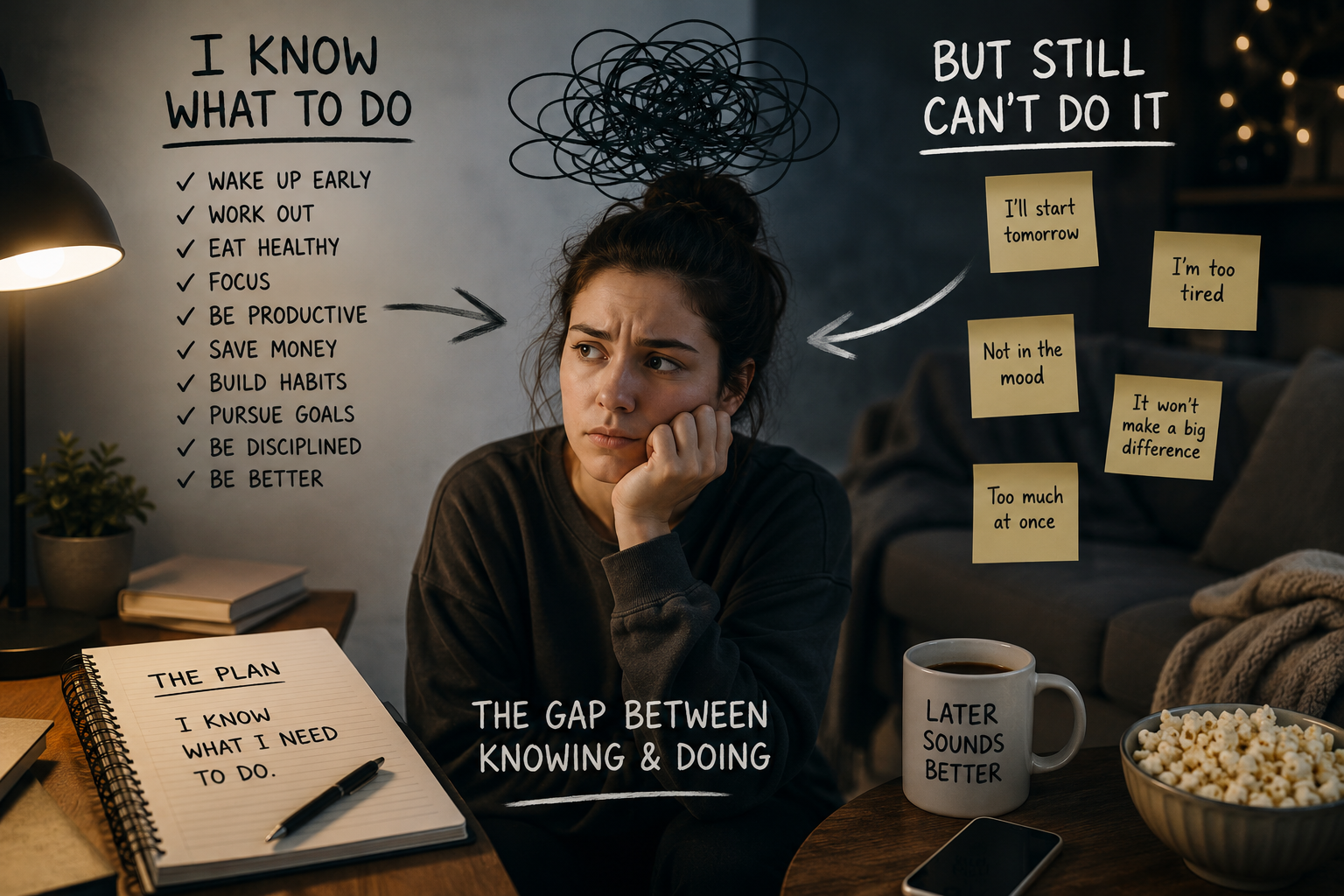
Why You Know What to Do… But Still Can’t Do It
You’ve thought about it. Planned for it. Maybe even told yourself, “Tomorrow, I’ll start.”
And then tomorrow comes… and nothing changes.
If this sounds familiar, you’re not alone—and you’re not lazy.
One of the most frustrating experiences people bring into therapy is this exact disconnect: knowing what to do, but feeling unable to actually do it. Whether it’s starting a task, setting a boundary, or making a needed life change, the gap between insight and action can feel confusing, discouraging, and, at times, deeply frustrating.
But this gap is not a failure of motivation. It’s often a reflection of something deeper.
It’s Not About Willpower
We’re often taught that if we’re not following through, we just need more discipline. That if we try harder, push more, or hold ourselves more accountable, things will click.
But research and clinical experience suggest otherwise.
In I Know What to Do, So Why Don’t I Do It?, Nick Hall (2022) explains that difficulty taking action is not simply about laziness or a lack of willpower, but rather the result of competing emotional and physiological processes. Motivation is not constant—it fluctuates and can become fatigued, especially when we’re already overwhelmed or under stress.
In other words, the issue isn’t that you don’t know what to do.
It’s that something is getting in the way of doing it.
The Role of Emotion (Not Logic)
Many people assume that behavior is driven by logic. If that were true, knowing what’s “best” would be enough.
But behavior is far more influenced by emotion than we tend to realize.
Procrastination, avoidance, and inaction are often forms of emotional regulation, not time management problems. We avoid tasks not because we don’t care—but because they bring up discomfort. That discomfort might look like anxiety, self-doubt, fear of failure, or even fear of success.
Hall (2022) emphasizes that action is shaped by how we feel about a task, not just what we think about it. When a task becomes associated with discomfort, the brain naturally moves away from it—even if the task itself is important or meaningful.
Why High-Functioning People Struggle Here
This disconnect is especially common in people who appear “high-functioning.”
On the outside, things often look steady and manageable:
You’re responsible
You get things done (eventually)
You show up for others
But internally, the experience can feel very different:
Overthinking everything
Difficulty starting or finishing tasks
Mental exhaustion
A constant sense of pressure
Because you can function, it becomes easy to assume you should function better. And when that expectation isn’t met, it can quickly turn into self-criticism.
That’s often where shame starts to build.
The Thought–Action Gap
Another important piece of this is how we mentally represent the things we need to do.
Hall (2022) describes how we don’t respond to reality itself, but to the mental images and beliefs we attach to it. If your internal narrative around a task is tied to past failure, criticism, or pressure, your brain reacts to that story, not the task itself.
This is why something small—like sending an email or starting a project—can feel disproportionately difficult.
It’s not the task.
It’s everything your brain has linked to it.
Why This Feels So Frustrating
When you know what to do but can’t follow through, it creates a very specific kind of frustration:
“Why can’t I just do it?”
“What’s wrong with me?”
“Other people don’t struggle like this.”
Over time, this internal dialogue can shift into self-criticism. And unfortunately, that tends to make action even harder.
Because when shame increases, avoidance tends to increase with it—creating a cycle that can feel difficult to break.
What Actually Helps
Closing the gap between knowing and doing isn’t about pushing harder—it’s about understanding what’s underneath.
In therapy, this often involves:
Identifying the emotional barriers connected to tasks
Understanding patterns like avoidance, perfectionism, or overwhelm
Reducing the pressure tied to performance
Building more realistic and sustainable ways of taking action
When we shift from “Why can’t I just do this?” to “What’s making this hard?”, the conversation changes—and so does the outcome.
Final Thoughts
If you’ve been stuck in the cycle of knowing but not doing, it doesn’t mean you’re unmotivated or incapable.
It often means your brain is responding to something that hasn’t been fully addressed yet.
And that’s something worth understanding—not judging.
References (APA 7th Edition)
Hall, N. (2022). I know what to do, so why don’t I do it? Mind your emotions to end procrastination and achieve all your goals (2nd ed.). G&D M
You’ve thought about it. Planned for it. Maybe even told yourself, “Tomorrow, I’ll start.”
And then tomorrow comes… and nothing changes.
If this sounds familiar, you’re not alone—and you’re not lazy.
One of the most frustrating experiences people bring into therapy is this exact disconnect: knowing what to do, but feeling unable to actually do it. Whether it’s starting a task, setting a boundary, or making a needed life change, the gap between insight and action can feel confusing, discouraging, and, at times, deeply frustrating.
But this gap is not a failure of motivation. It’s often a reflection of something deeper.
It’s Not About Willpower
We’re often taught that if we’re not following through, we just need more discipline. That if we try harder, push more, or hold ourselves more accountable, things will click.
But research and clinical experience suggest otherwise.
In I Know What to Do, So Why Don’t I Do It?, Nick Hall (2022) explains that difficulty taking action is not simply about laziness or a lack of willpower, but rather the result of competing emotional and physiological processes. Motivation is not constant—it fluctuates and can become fatigued, especially when we’re already overwhelmed or under stress.
In other words, the issue isn’t that you don’t know what to do.
It’s that something is getting in the way of doing it.
The Role of Emotion (Not Logic)
Many people assume that behavior is driven by logic. If that were true, knowing what’s “best” would be enough.
But behavior is far more influenced by emotion than we tend to realize.
Procrastination, avoidance, and inaction are often forms of emotional regulation, not time management problems. We avoid tasks not because we don’t care—but because they bring up discomfort. That discomfort might look like anxiety, self-doubt, fear of failure, or even fear of success.
Hall (2022) emphasizes that action is shaped by how we feel about a task, not just what we think about it. When a task becomes associated with discomfort, the brain naturally moves away from it—even if the task itself is important or meaningful.
Why High-Functioning People Struggle Here
This disconnect is especially common in people who appear “high-functioning.”
On the outside, things often look steady and manageable:
You’re responsible
You get things done (eventually)
You show up for others
But internally, the experience can feel very different:
Overthinking everything
Difficulty starting or finishing tasks
Mental exhaustion
A constant sense of pressure
Because you can function, it becomes easy to assume you should function better. And when that expectation isn’t met, it can quickly turn into self-criticism.
That’s often where shame starts to build.
The Thought–Action Gap
Another important piece of this is how we mentally represent the things we need to do.
Hall (2022) describes how we don’t respond to reality itself, but to the mental images and beliefs we attach to it. If your internal narrative around a task is tied to past failure, criticism, or pressure, your brain reacts to that story, not the task itself.
This is why something small—like sending an email or starting a project—can feel disproportionately difficult.
It’s not the task.
It’s everything your brain has linked to it.
Why This Feels So Frustrating
When you know what to do but can’t follow through, it creates a very specific kind of frustration:
“Why can’t I just do it?”
“What’s wrong with me?”
“Other people don’t struggle like this.”
Over time, this internal dialogue can shift into self-criticism. And unfortunately, that tends to make action even harder.
Because when shame increases, avoidance tends to increase with it—creating a cycle that can feel difficult to break.
What Actually Helps
Closing the gap between knowing and doing isn’t about pushing harder—it’s about understanding what’s underneath.
In therapy, this often involves:
Identifying the emotional barriers connected to tasks
Understanding patterns like avoidance, perfectionism, or overwhelm
Reducing the pressure tied to performance
Building more realistic and sustainable ways of taking action
When we shift from “Why can’t I just do this?” to “What’s making this hard?”, the conversation changes—and so does the outcome.
Final Thoughts
If you’ve been stuck in the cycle of knowing but not doing, it doesn’t mean you’re unmotivated or incapable.
It often means your brain is responding to something that hasn’t been fully addressed yet.
And that’s something worth understanding—not judging.
References (APA 7th Edition)
Hall, N. (2022). I know what to do, so why don’t I do it? Mind your emotions to end procrastination and achieve all your goals (2nd ed.). G&D Media.

Spring Break Pressure: When “Fun” Feels Like a Lot for Parents
Spring break is supposed to feel fun—but for many parents, it comes with pressure.
Pressure to plan something memorable. Pressure to keep kids entertained. Pressure to make the week feel special. And for many families, pressure to spend money—on trips, camps, and activities—at a time when everything already feels expensive.
While spring break is often portrayed as a carefree pause from routine, the reality for many parents looks very different. In fact, school breaks can create additional stress, not only because of increased childcare demands, but also because they disrupt the structure and support that families rely on during the school year.
One often overlooked stressor is financial. When school is in session, many families rely on consistent access to free or reduced-price meals. During spring break, that support disappears, leaving parents to fill the gap with additional grocery costs at a time when household budgets are already strained (Food Research & Action Center [FRAC], 2026). For some families, this can mean providing an extra 10 or more meals per child in a single week without any increase in income (Feed the Children, n.d.). As the cost of living continues to rise, these added expenses can significantly increase stress and pressure at home (FRAC, 2026).
Beyond finances, there is also the emotional pressure parents carry. It is easy to fall into the comparison trap—seeing curated images of vacations and activities and wondering if you are doing enough. Many parents begin to question themselves: Am I giving my kids enough? Are they missing out?
This kind of thinking is understandable, but it can also be misleading.
From a clinical perspective, children do not need a perfectly planned or highly stimulating week to feel secure and supported. In fact, research and clinical experience consistently show that children benefit from predictability, connection, and emotional availability more than constant entertainment.
When school is out, routines shift—and that can feel unsettling for both parents and children. Structure plays an important role in regulating mood, behavior, and even physical health. When that structure is removed, families may feel more dysregulated, which can increase stress levels across the household (Hopkins et al., 2023). This is often when parents feel the greatest pressure to “fill the gaps” with activities.
But filling every moment is not necessary—and in many cases, not helpful.
Children benefit from slower, unstructured time. Moments of boredom can support creativity, problem-solving, and independence. Simple activities—like watching a movie together, running errands, or spending time at home—can provide meaningful opportunities for connection and stability.
What matters most is not how much is planned, but how present and emotionally available a parent is during that time.
It is also important to acknowledge that stress during school breaks is not just about logistics—it is about the emotional weight parents carry. For some families, spring break highlights deeper concerns around financial stability, food access, and caregiving demands. These stressors can impact not only parents’ well-being but also children’s emotional and physical health (Feed the Children, n.d.).
If spring break feels more overwhelming than enjoyable, it may be a signal to scale things back.
Letting go of the expectation to create a “perfect” week can reduce pressure and allow for a more grounded, manageable experience. Children do not need a highlight reel—they need consistency, connection, and a sense of safety.
Keeping things simple is not a failure. In many ways, it is exactly what children need.
References
Feed the Children. (n.d.). Hungry kids during spring break: A real issue in the U.S. https://www.feedthechildren.org/our-work/stories/hungry-kids-during-spring-break-a-real-issue-in-the-u-s/
Food Research & Action Center. (2026). Let’s be crystal clear: Spring break highlights a hunger gap we can—and must—close. https://frac.org/blog/lets-be-crystal-clear-spring-break-highlights-a-hunger-gap-we-can-and-must-close
Hopkins, L., et al. (2023). Patterns of participation in summer programming among children from low-income households. https://pmc.ncbi.nlm.nih.gov/articles/PMC10598049/
Spring break is supposed to feel fun—but for many parents, it comes with pressure.
Pressure to plan something memorable. Pressure to keep kids entertained. Pressure to make the week feel special. And for many families, pressure to spend money—on trips, camps, and activities—at a time when everything already feels expensive.
While spring break is often portrayed as a carefree pause from routine, the reality for many parents looks very different. In fact, school breaks can create additional stress, not only because of increased childcare demands, but also because they disrupt the structure and support that families rely on during the school year.
One often overlooked stressor is financial. When school is in session, many families rely on consistent access to free or reduced-price meals. During spring break, that support disappears, leaving parents to fill the gap with additional grocery costs at a time when household budgets are already strained (Food Research & Action Center [FRAC], 2026). For some families, this can mean providing an extra 10 or more meals per child in a single week without any increase in income (Feed the Children, n.d.). As the cost of living continues to rise, these added expenses can significantly increase stress and pressure at home (FRAC, 2026).
Beyond finances, there is also the emotional pressure parents carry. It is easy to fall into the comparison trap—seeing curated images of vacations and activities and wondering if you are doing enough. Many parents begin to question themselves: Am I giving my kids enough? Are they missing out?
This kind of thinking is understandable, but it can also be misleading.
From a clinical perspective, children do not need a perfectly planned or highly stimulating week to feel secure and supported. In fact, research and clinical experience consistently show that children benefit from predictability, connection, and emotional availability more than constant entertainment.
When school is out, routines shift—and that can feel unsettling for both parents and children. Structure plays an important role in regulating mood, behavior, and even physical health. When that structure is removed, families may feel more dysregulated, which can increase stress levels across the household (Hopkins et al., 2023). This is often when parents feel the greatest pressure to “fill the gaps” with activities.
But filling every moment is not necessary—and in many cases, not helpful.
Children benefit from slower, unstructured time. Moments of boredom can support creativity, problem-solving, and independence. Simple activities—like watching a movie together, running errands, or spending time at home—can provide meaningful opportunities for connection and stability.
What matters most is not how much is planned, but how present and emotionally available a parent is during that time.
It is also important to acknowledge that stress during school breaks is not just about logistics—it is about the emotional weight parents carry. For some families, spring break highlights deeper concerns around financial stability, food access, and caregiving demands. These stressors can impact not only parents’ well-being but also children’s emotional and physical health (Feed the Children, n.d.).
If spring break feels more overwhelming than enjoyable, it may be a signal to scale things back.
Letting go of the expectation to create a “perfect” week can reduce pressure and allow for a more grounded, manageable experience. Children do not need a highlight reel—they need consistency, connection, and a sense of safety.
Keeping things simple is not a failure. In many ways, it is exactly what children need.
References
Feed the Children. (n.d.). Hungry kids during spring break: A real issue in the U.S. https://www.feedthechildren.org/our-work/stories/hungry-kids-during-spring-break-a-real-issue-in-the-u-s/
Food Research & Action Center. (2026). Let’s be crystal clear: Spring break highlights a hunger gap we can—and must—close. https://frac.org/blog/lets-be-crystal-clear-spring-break-highlights-a-hunger-gap-we-can-and-must-close
Hopkins, L., et al. (2023). Patterns of participation in summer programming among children from low-income households. https://pmc.ncbi.nlm.nih.gov/articles/PMC10598049/

On Paper, You’re Thriving. Inside, You’re Exhausted.
From the outside, it looks like you have it together.
You’re meeting deadlines. Showing up to meetings. Answering emails. Managing responsibilities. Maybe even advancing in your career.
But internally, it’s a different story.
Your mind doesn’t shut off. You replay conversations. You overthink decisions that shouldn’t feel this heavy. There’s a constant pressure to stay on top of everything—because if you’re not, something might slip.
And most people don’t see that part.
Anxiety in high-functioning professionals doesn’t always look like panic. More often, it looks like competence.
It shows up as over-preparing, staying mentally “on” long after the workday ends, and holding yourself to a standard that keeps moving just out of reach. You might have a hard time relaxing without feeling guilty, or find yourself questioning whether you’re doing enough—even when there’s plenty of evidence that you are.
People experiencing high-functioning anxiety often appear capable and successful on the outside, while internally managing ongoing pressure, worry, and self-doubt (NewYork-Presbyterian, 2023). In a lot of ways, it blends in so well that it can be hard to recognize—even for the person experiencing it.
Part of what makes this so tricky is that in many corporate environments, these patterns are reinforced. Being detail-oriented, responsive, and always available is often rewarded. You might be known as reliable, driven, or someone who always delivers.
But what’s underneath that performance often gets missed.
There’s a quiet cycle that can develop over time: you feel anxious, so you push harder. You succeed, which reinforces the idea that the anxiety is necessary. And slowly, that pressure starts to feel like the thing holding everything together.
Because you’re still functioning—often at a high level—it’s easy to tell yourself nothing is really wrong. But research and clinical insight continue to show that many professionals maintain high levels of performance while experiencing significant internal stress, often without ever seeking support (McLean Hospital, 2025; Starner, 2024).
A lot of people in these roles don’t talk about their anxiety—not because it isn’t there, but because of what it might mean to admit it.
There’s often a quiet narrative running in the background: I should be able to handle this. This is just part of the job. If I slow down, everything will fall apart.
And in leadership or high-responsibility roles, there can be an added pressure to appear steady, capable, and in control. Conversations around executive mental health are starting to acknowledge just how common anxiety is at higher levels of responsibility, even if it’s rarely talked about openly (Starner, 2024; Hyder, 2021).
So instead, you keep going.
Even when you’re exhausted.
At some point, though, it starts to show up in other ways. Your mind won’t shut off at night. You feel tense even during downtime. You’re physically present, but mentally still working through your to-do list. Small things start to feel heavier than they should.
High-functioning anxiety tends to run on a loop—where productivity temporarily relieves the anxiety, but never actually resolves it (Anderson, 2025). So you keep doing more, thinking it will eventually feel easier.
But it usually doesn’t.
Most high-functioning professionals don’t need more strategies for doing more. What they often need is space to step out of constant pressure.
That can start with noticing when anxiety—not intention—is driving your decisions. It can look like practicing boundaries without immediately labeling them as failure, or learning how to slow down without guilt taking over.
It also means beginning to untangle the idea that your worth is tied to how much you produce.
And that’s not always an easy shift—especially if pushing yourself is what’s helped you get where you are.
Therapy in this space isn’t about taking away your ambition or lowering your standards. It’s about helping you function without relying on constant pressure as your baseline.
That might look like learning how to respond differently to anxious thoughts, reducing the mental load you’re carrying, and creating a more sustainable way of showing up—not just at work, but in your life overall. Approaches like CBT and mindfulness-based strategies can be especially helpful in reducing anxiety while still supporting high levels of functioning (NewYork-Presbyterian, 2023).
You can be successful and struggling at the same time.
Both can be true.
And if you’ve been holding it together on the outside while feeling overwhelmed on the inside—you’re not the only one.
You don’t have to wait until things fall apart to take your anxiety seriously.
References:
Anderson, M. (2025). Managing high-functioning anxiety in professionals. https://drmalcolmanderson.net/2025/08/13/managing-high-functioning-anxiety-in-professionals/
Hyder, S. (2021). How conquering executive anxiety can make you a better, happier leader. Forbes. https://www.forbes.com/sites/shamahyder/2021/03/29/how-conquering-executive-anxiety-can-make-you-a-better-happier-leader/
McLean Hospital. (2025.). The silent strain: Top mental health concerns among executive leadership. https://www.mcleanhospital.org/news/silent-strain-top-mental-health-among-executive-leadership
NewYork-Presbyterian. (2023). What is high-functioning anxiety? https://healthmatters.nyp.org/what-is-high-functioning-anxiety/
Starner,T. (2024.). Heavy is the head that wears the crown: The state of CEO mental health. https://worldatwork.org/publications/workspan-daily/heavy-is-the-head-that-wears-the-crown-the-state-of-ceo-mental-health
From the outside, it looks like you have it together.
You’re meeting deadlines. Showing up to meetings. Answering emails. Managing responsibilities. Maybe even advancing in your career.
But internally, it’s a different story.
Your mind doesn’t shut off. You replay conversations. You overthink decisions that shouldn’t feel this heavy. There’s a constant pressure to stay on top of everything—because if you’re not, something might slip.
And most people don’t see that part.
Anxiety in high-functioning professionals doesn’t always look like panic. More often, it looks like competence.
It shows up as over-preparing, staying mentally “on” long after the workday ends, and holding yourself to a standard that keeps moving just out of reach. You might have a hard time relaxing without feeling guilty, or find yourself questioning whether you’re doing enough—even when there’s plenty of evidence that you are.
People experiencing high-functioning anxiety often appear capable and successful on the outside, while internally managing ongoing pressure, worry, and self-doubt (NewYork-Presbyterian, 2023). In a lot of ways, it blends in so well that it can be hard to recognize—even for the person experiencing it.
Part of what makes this so tricky is that in many corporate environments, these patterns are reinforced. Being detail-oriented, responsive, and always available is often rewarded. You might be known as reliable, driven, or someone who always delivers.
But what’s underneath that performance often gets missed.
There’s a quiet cycle that can develop over time: you feel anxious, so you push harder. You succeed, which reinforces the idea that the anxiety is necessary. And slowly, that pressure starts to feel like the thing holding everything together.
Because you’re still functioning—often at a high level—it’s easy to tell yourself nothing is really wrong. But research and clinical insight continue to show that many professionals maintain high levels of performance while experiencing significant internal stress, often without ever seeking support (McLean Hospital, 2025; Starner, 2024).
A lot of people in these roles don’t talk about their anxiety—not because it isn’t there, but because of what it might mean to admit it.
There’s often a quiet narrative running in the background: I should be able to handle this. This is just part of the job. If I slow down, everything will fall apart.
And in leadership or high-responsibility roles, there can be an added pressure to appear steady, capable, and in control. Conversations around executive mental health are starting to acknowledge just how common anxiety is at higher levels of responsibility, even if it’s rarely talked about openly (Starner, 2024; Hyder, 2021).
So instead, you keep going.
Even when you’re exhausted.
At some point, though, it starts to show up in other ways. Your mind won’t shut off at night. You feel tense even during downtime. You’re physically present, but mentally still working through your to-do list. Small things start to feel heavier than they should.
High-functioning anxiety tends to run on a loop—where productivity temporarily relieves the anxiety, but never actually resolves it (Anderson, 2025). So you keep doing more, thinking it will eventually feel easier.
But it usually doesn’t.
Most high-functioning professionals don’t need more strategies for doing more. What they often need is space to step out of constant pressure.
That can start with noticing when anxiety—not intention—is driving your decisions. It can look like practicing boundaries without immediately labeling them as failure, or learning how to slow down without guilt taking over.
It also means beginning to untangle the idea that your worth is tied to how much you produce.
And that’s not always an easy shift—especially if pushing yourself is what’s helped you get where you are.
Therapy in this space isn’t about taking away your ambition or lowering your standards. It’s about helping you function without relying on constant pressure as your baseline.
That might look like learning how to respond differently to anxious thoughts, reducing the mental load you’re carrying, and creating a more sustainable way of showing up—not just at work, but in your life overall. Approaches like CBT and mindfulness-based strategies can be especially helpful in reducing anxiety while still supporting high levels of functioning (NewYork-Presbyterian, 2023).
You can be successful and struggling at the same time.
Both can be true.
And if you’ve been holding it together on the outside while feeling overwhelmed on the inside—you’re not the only one.
You don’t have to wait until things fall apart to take your anxiety seriously.
References:
Anderson, M. (2025). Managing high-functioning anxiety in professionals. https://drmalcolmanderson.net/2025/08/13/managing-high-functioning-anxiety-in-professionals/
Hyder, S. (2021). How conquering executive anxiety can make you a better, happier leader. Forbes. https://www.forbes.com/sites/shamahyder/2021/03/29/how-conquering-executive-anxiety-can-make-you-a-better-happier-leader/
McLean Hospital. (2025.). The silent strain: Top mental health concerns among executive leadership. https://www.mcleanhospital.org/news/silent-strain-top-mental-health-among-executive-leadership
NewYork-Presbyterian. (2023). What is high-functioning anxiety? https://healthmatters.nyp.org/what-is-high-functioning-anxiety/
Starner,T. (2024.). Heavy is the head that wears the crown: The state of CEO mental health. https://worldatwork.org/publications/workspan-daily/heavy-is-the-head-that-wears-the-crown-the-state-of-ceo-mental-health

Gen Z Anxiety and Chronic Stress: Why So Many Young Adults Feel Overwhelmed
In recent years, mental health professionals, educators, and researchers have increasingly focused on a growing trend: Generation Z is reporting higher levels of anxiety and chronic stress than previous generations. While stress has always been part of adolescence and early adulthood, many experts believe the intensity and persistence of what young people are experiencing today is different.
Generation Z—often defined as individuals born between 1997 and 2012—includes today’s teenagers, college students, and young adults entering the workforce. What makes this generation unique is the environment in which they have grown up. Gen Z is widely considered the first generation to be fully immersed in a digital world, where smartphones, social media, and constant connectivity have shaped everyday life from childhood through adulthood.
Research consistently shows that younger adults report higher stress levels compared to older generations. According to the American Psychological Association, many young adults report feeling overwhelmed by financial pressures, social expectations, and uncertainty about the future, contributing to elevated stress and anxiety levels among Gen Z (American Psychological Association, 2023). Similarly, global research examining generational stress trends found that Gen Z reports higher stress levels than any other generation, highlighting the unique pressures young people face today (GlobeScan, 2024).
One factor frequently discussed in relation to Gen Z mental health is the influence of social media and digital comparison. While online platforms offer connection and community, they also create environments where comparison is constant. Young people are often exposed to carefully curated versions of others’ lives, which can increase pressure to meet perceived standards of success and happiness. Research examining well-being among Generation Z suggests that external factors such as digital environments, societal expectations, and rapid social change can contribute to heightened stress and psychological strain (Dwidienawati, 2024).
Academic and career expectations can also contribute to this pressure. Many students feel they must maintain strong grades, participate in extracurricular activities, prepare early for competitive college or career paths, and build impressive resumes before entering adulthood. For high-achieving students, this environment can lead to perfectionism, burnout, and fear of failure, even when they are performing well by external standards.
Another important influence on Gen Z mental health is the developmental disruption that occurred during the COVID-19 pandemic. Many adolescents and young adults experienced significant interruptions during key developmental periods that typically involve social connection, independence, and identity formation. Social isolation, disrupted schooling, and uncertainty about the future occurred during a stage when young people are still developing emotional regulation and coping skills.
Clinicians and researchers have also noted increasing rates of social anxiety among Gen Z, particularly among young people who rely heavily on digital communication. While online communication can provide connection, it may reduce opportunities to develop confidence in face-to-face interactions and social environments. At the same time, mental health professionals note that Gen Z demonstrates an important strength: this generation is often more open to discussing mental health and seeking professional support than previous generations (National Social Anxiety Center, 2024).
Across therapy practices in Maryland and throughout the country, many Gen Z clients share a similar pattern. They often appear high-functioning externally but overwhelmed internally. Many are successful students or young professionals who continue to meet expectations, yet privately struggle with chronic anxiety, mental fatigue, perfectionism, and difficulty focusing. Executive functioning challenges—such as difficulty initiating tasks, organizing responsibilities, or managing deadlines—are also common and can intensify feelings of stress and self-criticism.
This pattern can be particularly confusing because these young adults often appear capable and motivated. They may still attend classes, maintain employment, or perform well academically, which can make it harder for others to recognize how much internal pressure they are experiencing. Many describe feeling as though they are constantly trying to keep up, even when they are doing well by traditional measures.
Understanding Gen Z anxiety is important not only for young people themselves but also for the families, educators, and communities around them. Parents often see their children working extremely hard but may not always realize how much emotional strain they are carrying. Educators are increasingly supporting students who are capable but overwhelmed, while employers are beginning to recognize that mental health and workplace expectations are closely connected as Gen Z enters the workforce.
Despite the challenges, Gen Z also brings strengths that can support positive mental health outcomes. Many young people today are highly emotionally aware, open to discussing mental health, and willing to seek professional support. Therapy can provide a space where young adults learn practical tools to manage anxiety, reduce perfectionism, and strengthen executive functioning skills. With the right support, many can develop healthier ways of balancing ambition, expectations, and well-being.
References
American Psychological Association. (2023). Gen Z adults and younger millennials are completely overwhelmed by stress. https://www.apa.org/topics/stress/generation-z-millennials-young-adults-worries
Dwidienawati, D. (2024). Factors influencing Generation Z wellbeing and stress. National Library of Medicine. https://pmc.ncbi.nlm.nih.gov/articles/PMC11683866/
GlobeScan. (2024, February 1). Insight of the week: Gen Z is experiencing more stress than any other generation. https://globescan.com/2024/02/01/insight-of-the-week-gen-z-is-experiencing-more-stress-than-any-other-generation/
National Social Anxiety Center. (2024, August 19). Social anxiety in Generation Z. https://nationalsocialanxietycenter.com/2024/08/19/social-anxiety-in-generation-z/
In recent years, mental health professionals, educators, and researchers have increasingly focused on a growing trend: Generation Z is reporting higher levels of anxiety and chronic stress than previous generations. While stress has always been part of adolescence and early adulthood, many experts believe the intensity and persistence of what young people are experiencing today is different.
Generation Z—often defined as individuals born between 1997 and 2012—includes today’s teenagers, college students, and young adults entering the workforce. What makes this generation unique is the environment in which they have grown up. Gen Z is widely considered the first generation to be fully immersed in a digital world, where smartphones, social media, and constant connectivity have shaped everyday life from childhood through adulthood.
Research consistently shows that younger adults report higher stress levels compared to older generations. According to the American Psychological Association, many young adults report feeling overwhelmed by financial pressures, social expectations, and uncertainty about the future, contributing to elevated stress and anxiety levels among Gen Z (American Psychological Association, 2023). Similarly, global research examining generational stress trends found that Gen Z reports higher stress levels than any other generation, highlighting the unique pressures young people face today (GlobeScan, 2024).
One factor frequently discussed in relation to Gen Z mental health is the influence of social media and digital comparison. While online platforms offer connection and community, they also create environments where comparison is constant. Young people are often exposed to carefully curated versions of others’ lives, which can increase pressure to meet perceived standards of success and happiness. Research examining well-being among Generation Z suggests that external factors such as digital environments, societal expectations, and rapid social change can contribute to heightened stress and psychological strain (Dwidienawati, 2024).
Academic and career expectations can also contribute to this pressure. Many students feel they must maintain strong grades, participate in extracurricular activities, prepare early for competitive college or career paths, and build impressive resumes before entering adulthood. For high-achieving students, this environment can lead to perfectionism, burnout, and fear of failure, even when they are performing well by external standards.
Another important influence on Gen Z mental health is the developmental disruption that occurred during the COVID-19 pandemic. Many adolescents and young adults experienced significant interruptions during key developmental periods that typically involve social connection, independence, and identity formation. Social isolation, disrupted schooling, and uncertainty about the future occurred during a stage when young people are still developing emotional regulation and coping skills.
Clinicians and researchers have also noted increasing rates of social anxiety among Gen Z, particularly among young people who rely heavily on digital communication. While online communication can provide connection, it may reduce opportunities to develop confidence in face-to-face interactions and social environments. At the same time, mental health professionals note that Gen Z demonstrates an important strength: this generation is often more open to discussing mental health and seeking professional support than previous generations (National Social Anxiety Center, 2024).
Across therapy practices in Maryland and throughout the country, many Gen Z clients share a similar pattern. They often appear high-functioning externally but overwhelmed internally. Many are successful students or young professionals who continue to meet expectations, yet privately struggle with chronic anxiety, mental fatigue, perfectionism, and difficulty focusing. Executive functioning challenges—such as difficulty initiating tasks, organizing responsibilities, or managing deadlines—are also common and can intensify feelings of stress and self-criticism.
This pattern can be particularly confusing because these young adults often appear capable and motivated. They may still attend classes, maintain employment, or perform well academically, which can make it harder for others to recognize how much internal pressure they are experiencing. Many describe feeling as though they are constantly trying to keep up, even when they are doing well by traditional measures.
Understanding Gen Z anxiety is important not only for young people themselves but also for the families, educators, and communities around them. Parents often see their children working extremely hard but may not always realize how much emotional strain they are carrying. Educators are increasingly supporting students who are capable but overwhelmed, while employers are beginning to recognize that mental health and workplace expectations are closely connected as Gen Z enters the workforce.
Despite the challenges, Gen Z also brings strengths that can support positive mental health outcomes. Many young people today are highly emotionally aware, open to discussing mental health, and willing to seek professional support. Therapy can provide a space where young adults learn practical tools to manage anxiety, reduce perfectionism, and strengthen executive functioning skills. With the right support, many can develop healthier ways of balancing ambition, expectations, and well-being.
References
American Psychological Association. (2023). Gen Z adults and younger millennials are completely overwhelmed by stress. https://www.apa.org/topics/stress/generation-z-millennials-young-adults-worries
Dwidienawati, D. (2024). Factors influencing Generation Z wellbeing and stress. National Library of Medicine. https://pmc.ncbi.nlm.nih.gov/articles/PMC11683866/
GlobeScan. (2024, February 1). Insight of the week: Gen Z is experiencing more stress than any other generation. https://globescan.com/2024/02/01/insight-of-the-week-gen-z-is-experiencing-more-stress-than-any-other-generation/
National Social Anxiety Center. (2024, August 19). Social anxiety in Generation Z. https://nationalsocialanxietycenter.com/2024/08/19/social-anxiety-in-generation-z/

AI Therapy vs. Human Therapy: What You Should Know Before Turning to Chatbots for Mental Health Support
Artificial intelligence (AI) is rapidly entering the mental health space. From therapy chatbots to mood-tracking apps and AI companions, many people are exploring digital tools to support their emotional well-being.
If you’ve found yourself wondering whether talking to an app might be enough support, you’re not alone. Many thoughtful, high-functioning adults are asking:
“If AI is available anytime, do I still need therapy with a human?”
The answer isn’t black and white. AI tools can be helpful in certain situations — and at the same time, they have important limitations. Understanding the difference can help you make the most informed and supportive choice for your mental health.
The Rise of AI in Mental Health Support
There’s a reason AI mental health tools have grown quickly in popularity. Many platforms offer:
24/7 accessibility
Immediate responses
Lower-cost or free options
Guided coping exercises
Mood tracking and journaling prompts
For someone who feels hesitant about starting therapy, overwhelmed by the process, or simply curious about self-help, these tools can feel like a gentle first step.
Experts note that AI has the potential to expand access to basic mental health resources and psychoeducation, particularly for individuals who face barriers to traditional care (Johns Hopkins Bloomberg School of Public Health, 2026; National Alliance on Mental Illness [NAMI], 2024).
Used thoughtfully, AI can serve as a supportive adjunct tool. However, supportive tools are not the same as clinical treatment.
Why AI Support Is Different From Human Therapy
While AI can simulate conversation, therapy with a licensed clinician involves something much deeper and more personalized.
Human therapy includes clinical assessment, ethical and legal accountability, individualized treatment planning, risk evaluation, and real-time emotional attunement. Therapists also draw on years of training and supervised experience to understand patterns in a client’s history, relationships, and emotional responses.
AI systems generate responses based on patterns in data. They do not truly understand a person’s lived experience, trauma history, or the subtle ways emotions and behaviors change over time (Mental Health Journal, 2025).
Therapy is not simply conversation — it is a structured healthcare service grounded in professional training, ethical responsibility, and the therapeutic relationship.
Clinical and Ethical Risks of AI in Mental Health Care
While AI tools may be helpful for mild stress or self-reflection, relying on them as a primary form of mental health care raises several concerns.
Research suggests AI systems may oversimplify complex psychological experiences or miss important diagnostic indicators that trained clinicians would explore more deeply (U.S. National Library of Medicine, 2024). In addition, AI chatbots are not equipped to conduct full suicide risk assessments or intervene during mental health crises. Stanford researchers have found that some therapy chatbots struggled to respond appropriately to high-risk mental health scenarios (Stanford Human-Centered Artificial Intelligence Institute, 2025).
There are also broader ethical considerations. Mental health conversations contain highly personal information, yet many AI platforms are not bound by the same confidentiality and ethical standards required of licensed clinicians. Users may not fully understand how their data are stored, used, or shared (National Alliance on Mental Illness, 2024).
Public health experts have also raised concerns about algorithmic bias. Because AI systems are trained on existing datasets, they may interpret symptoms differently across cultural or demographic groups, potentially widening disparities in care (Johns Hopkins Bloomberg School of Public Health, 2026).
For these reasons, many experts emphasize that AI tools should be used cautiously and ideally alongside human clinical oversight.
When AI Tools May Be Helpful — and When Human Support Matters More
AI mental health tools can be useful for certain purposes, such as tracking mood patterns, practicing coping skills, engaging in guided journaling, or learning basic psychoeducation. Some individuals also find them helpful while waiting to access therapy or as a supplement between sessions.
However, working with a licensed therapist is especially important when someone is experiencing persistent anxiety or depression, trauma-related concerns, ADHD or executive functioning challenges, relationship stress, grief, or significant life transitions.
Therapy provides something that technology cannot replicate: a real human relationship where someone is listening carefully, asking thoughtful questions, and helping you understand patterns that may not be obvious on your own.
Telehealth has also made therapy more accessible than ever, allowing many people to receive personalized care from the comfort of home while still benefiting from meaningful human connection.
Wondering What Kind of Support Is Right for You?
If you’ve been exploring AI tools but still feel like something is missing, you’re not doing anything wrong. Many thoughtful, capable adults try to manage things on their own first. Turning to apps, podcasts, or self-help tools can be a meaningful step toward understanding what you’re experiencing.
But sometimes what people are really needing isn’t more information — it’s a space to slow down, feel understood, and talk through what’s actually underneath the stress or overwhelm.
While technology can offer helpful reminders or coping strategies, it can’t replace the experience of sitting with a trained professional who can listen, ask thoughtful questions, and help you make sense of what you’re going through.
If you’re feeling stretched thin, managing anxiety, navigating ADHD or executive functioning challenges, or simply wondering whether additional support could help, therapy can offer a place to explore that without pressure or judgment.
You don’t have to have everything figured out before reaching out. Curiosity is enough.
And when you’re ready, meaningful, human support is available.
References:
Johns Hopkins Bloomberg School of Public Health. (2026). Experts discuss the impact of AI on mental health. Johns Hopkins University. https://publichealth.jhu.edu/2026/experts-discuss-the-impact-of-ai-on-mental-health
National Alliance on Mental Illness. (2024). AI and mental health. https://www.nami.org/ai-and-mental-health/
Stanford Human-Centered Artificial Intelligence Institute. (2025). Exploring the dangers of AI in mental health care. Stanford University. https://hai.stanford.edu/news/exploring-the-dangers-of-ai-in-mental-health-care
U.S. National Library of Medicine. (2024). Artificial intelligence in mental health care (PMC11687125). PubMed Central. https://pmc.ncbi.nlm.nih.gov/articles/PMC11687125/
Mental Health Journal. (2025). Minds in crisis: How the AI revolution is impacting mental health. https://www.mentalhealthjournal.org/articles/minds-in-crisis-how-the-ai-revolution-is-impacting-mental-health.html
Artificial intelligence (AI) is rapidly entering the mental health space. From therapy chatbots to mood-tracking apps and AI companions, many people are exploring digital tools to support their emotional well-being.
If you’ve found yourself wondering whether talking to an app might be enough support, you’re not alone. Many thoughtful, high-functioning adults are asking:
“If AI is available anytime, do I still need therapy with a human?”
The answer isn’t black and white. AI tools can be helpful in certain situations — and at the same time, they have important limitations. Understanding the difference can help you make the most informed and supportive choice for your mental health.
The Rise of AI in Mental Health Support
There’s a reason AI mental health tools have grown quickly in popularity. Many platforms offer:
24/7 accessibility
Immediate responses
Lower-cost or free options
Guided coping exercises
Mood tracking and journaling prompts
For someone who feels hesitant about starting therapy, overwhelmed by the process, or simply curious about self-help, these tools can feel like a gentle first step.
Experts note that AI has the potential to expand access to basic mental health resources and psychoeducation, particularly for individuals who face barriers to traditional care (Johns Hopkins Bloomberg School of Public Health, 2026; National Alliance on Mental Illness [NAMI], 2024).
Used thoughtfully, AI can serve as a supportive adjunct tool. However, supportive tools are not the same as clinical treatment.
Why AI Support Is Different From Human Therapy
While AI can simulate conversation, therapy with a licensed clinician involves something much deeper and more personalized.
Human therapy includes clinical assessment, ethical and legal accountability, individualized treatment planning, risk evaluation, and real-time emotional attunement. Therapists also draw on years of training and supervised experience to understand patterns in a client’s history, relationships, and emotional responses.
AI systems generate responses based on patterns in data. They do not truly understand a person’s lived experience, trauma history, or the subtle ways emotions and behaviors change over time (Mental Health Journal, 2025).
Therapy is not simply conversation — it is a structured healthcare service grounded in professional training, ethical responsibility, and the therapeutic relationship.
Clinical and Ethical Risks of AI in Mental Health Care
While AI tools may be helpful for mild stress or self-reflection, relying on them as a primary form of mental health care raises several concerns.
Research suggests AI systems may oversimplify complex psychological experiences or miss important diagnostic indicators that trained clinicians would explore more deeply (U.S. National Library of Medicine, 2024). In addition, AI chatbots are not equipped to conduct full suicide risk assessments or intervene during mental health crises. Stanford researchers have found that some therapy chatbots struggled to respond appropriately to high-risk mental health scenarios (Stanford Human-Centered Artificial Intelligence Institute, 2025).
There are also broader ethical considerations. Mental health conversations contain highly personal information, yet many AI platforms are not bound by the same confidentiality and ethical standards required of licensed clinicians. Users may not fully understand how their data are stored, used, or shared (National Alliance on Mental Illness, 2024).
Public health experts have also raised concerns about algorithmic bias. Because AI systems are trained on existing datasets, they may interpret symptoms differently across cultural or demographic groups, potentially widening disparities in care (Johns Hopkins Bloomberg School of Public Health, 2026).
For these reasons, many experts emphasize that AI tools should be used cautiously and ideally alongside human clinical oversight.
When AI Tools May Be Helpful — and When Human Support Matters More
AI mental health tools can be useful for certain purposes, such as tracking mood patterns, practicing coping skills, engaging in guided journaling, or learning basic psychoeducation. Some individuals also find them helpful while waiting to access therapy or as a supplement between sessions.
However, working with a licensed therapist is especially important when someone is experiencing persistent anxiety or depression, trauma-related concerns, ADHD or executive functioning challenges, relationship stress, grief, or significant life transitions.
Therapy provides something that technology cannot replicate: a real human relationship where someone is listening carefully, asking thoughtful questions, and helping you understand patterns that may not be obvious on your own.
Telehealth has also made therapy more accessible than ever, allowing many people to receive personalized care from the comfort of home while still benefiting from meaningful human connection.
Wondering What Kind of Support Is Right for You?
If you’ve been exploring AI tools but still feel like something is missing, you’re not doing anything wrong. Many thoughtful, capable adults try to manage things on their own first. Turning to apps, podcasts, or self-help tools can be a meaningful step toward understanding what you’re experiencing.
But sometimes what people are really needing isn’t more information — it’s a space to slow down, feel understood, and talk through what’s actually underneath the stress or overwhelm.
While technology can offer helpful reminders or coping strategies, it can’t replace the experience of sitting with a trained professional who can listen, ask thoughtful questions, and help you make sense of what you’re going through.
If you’re feeling stretched thin, managing anxiety, navigating ADHD or executive functioning challenges, or simply wondering whether additional support could help, therapy can offer a place to explore that without pressure or judgment.
You don’t have to have everything figured out before reaching out. Curiosity is enough.
And when you’re ready, meaningful, human support is available.
References:
Johns Hopkins Bloomberg School of Public Health. (2026). Experts discuss the impact of AI on mental health. Johns Hopkins University. https://publichealth.jhu.edu/2026/experts-discuss-the-impact-of-ai-on-mental-health
National Alliance on Mental Illness. (2024). AI and mental health. https://www.nami.org/ai-and-mental-health/
Stanford Human-Centered Artificial Intelligence Institute. (2025). Exploring the dangers of AI in mental health care. Stanford University. https://hai.stanford.edu/news/exploring-the-dangers-of-ai-in-mental-health-care
U.S. National Library of Medicine. (2024). Artificial intelligence in mental health care (PMC11687125). PubMed Central. https://pmc.ncbi.nlm.nih.gov/articles/PMC11687125/
Mental Health Journal. (2025). Minds in crisis: How the AI revolution is impacting mental health. https://www.mentalhealthjournal.org/articles/minds-in-crisis-how-the-ai-revolution-is-impacting-mental-health.html

What Is Neurodivergence? A Guide to Understanding Neurodiversity and Support
In recent years, the term neurodivergence has become more visible in conversations about mental health, education, and workplace inclusion. Yet many people are still unsure what it truly means—or how it may relate to their own experiences or those of their children.
Understanding neurodivergence through a compassionate, evidence-informed lens can reduce stigma, support self-awareness, and promote more effective care.
What Is Neurodivergence?
Neurodivergence refers to natural variations in how the brain develops and functions. A neurodivergent person’s brain processes information, learns, communicates, or experiences the environment differently from what is considered neurotypical (Cleveland Clinic, n.d.).
The broader concept of neurodiversity recognizes that these neurological differences are part of normal human variation rather than inherently deficits (Northwestern Medicine, n.d.). Rather than viewing differences as problems to be “fixed,” the neurodiversity framework emphasizes understanding, accommodation, and support.
Common neurodivergent identities and diagnoses include:
Autism spectrum disorder (ASD)
Attention-deficit/hyperactivity disorder (ADHD)
Dyslexia and other learning differences
Dyspraxia
Tourette syndrome
Importantly, neurodivergence is not a single condition but an umbrella term describing many neurological profiles.
How Common Is Neurodivergence?
Neurodivergence is more common than many people realize. Estimates suggest a meaningful portion of the population has learning, attention, or developmental differences that fall under the neurodiversity umbrella.
Increased awareness, improved screening, and better understanding of how neurodivergence presents—especially in girls, women, and culturally diverse populations—have contributed to more frequent identification in recent years.
Strengths Often Associated With Neurodivergence
While neurodivergent individuals may experience challenges in environments designed for neurotypical norms, many also demonstrate distinct strengths.
Research and clinical observations commonly note:
Creative or divergent thinking
Strong pattern recognition
Deep focus on areas of interest
High attention to detail
Innovative problem-solving
A strengths-based lens does not ignore areas of difficulty. Instead, it supports a more balanced and respectful understanding of neurodivergent individuals (NNLM, n.d.).
Common Challenges Neurodivergent Individuals May Face
Because many systems (schools, workplaces, and social expectations) are built around neurotypical norms, neurodivergent individuals may experience increased stress or mismatch with their environments.
Executive functioning differences
Organization and time management
Task initiation
Working memory
Sensory sensitivities
Heightened responses to noise, light, textures, or crowds
Sensory overload and fatigue
Social communication differences
Interpreting social cues
Navigating unspoken social rules
Masking or camouflaging behaviors
Emotional regulation differences
Heightened stress responses
Burnout
Anxiety or depression secondary to chronic stress
It is important to note that not every neurodivergent person experiences the same challenges, and support needs vary widely.
The Impact of Late Identification
Many adolescents and adults—particularly women, people of color, and high-masking individuals—are identified later in life. Increased awareness has helped highlight groups that were historically underdiagnosed.
Late identification can bring complex emotions.
Potential relief
Greater self-understanding
Language for lifelong experiences
Access to appropriate supports
Possible grief or frustration
Feeling misunderstood in the past
Burnout from years of masking
Missed accommodations or support
Supportive therapy can be especially helpful during this adjustment process.
How Therapy Supports Neurodiversity
Neurodiversity-affirming therapy shifts the focus from trying to make neurodivergent individuals appear neurotypical to helping them function, cope, and thrive in ways that honor their neurological differences (University of St. Augustine for Health Sciences, 2023).
Key principles of neurodiversity-affirming therapy
1. Respect for neurological differences
Therapy recognizes neurodivergence as a natural variation in human brains rather than something inherently disordered.
2. Strengths-based approach
Clinicians intentionally identify and build upon client strengths alongside addressing areas of difficulty.
3. Reduction of harmful masking
Rather than encouraging constant camouflage of traits, therapy supports authenticity while teaching context-appropriate coping skills.
4. Environmental fit and accommodations
Support often includes modifying environments, routines, and expectations—not just changing the individual.
5. Collaborative, client-centered care
Neurodiversity-affirming therapists work with clients (and families when appropriate) to develop practical, individualized supports.
Therapeutic supports may include:
Psychoeducation about neurodivergence
Executive functioning skill development
Sensory regulation strategies
Emotional regulation tools
Self-advocacy and boundary setting
Burnout prevention and recovery
Support for co-occurring anxiety, depression, or trauma
When therapy is affirming and individualized, neurodivergent individuals often experience improved self-understanding, reduced shame, and better day-to-day functioning.
A Neurodiversity-Affirming Perspective
The neurodiversity movement encourages an important shift in perspective:
From deficit → difference
From compliance → support
From masking → authenticity
From one-size-fits-all → individualized care
At the same time, a balanced clinical view acknowledges that many neurodivergent individuals do experience real functional challenges that deserve compassionate, evidence-based support.
Both realities can coexist.
Final Thoughts
Neurodivergence represents the rich diversity of human brains and experiences. With increased awareness, earlier identification, and neurodiversity-affirming care, individuals and families can better understand their needs and build environments that support thriving—not just coping.
References:
Cleveland Clinic. (n.d.). Neurodivergent: What it means & types. Cleveland Clinic. https://my.clevelandclinic.org/health/symptoms/23154-neurodivergent.
Network of the National Library of Medicine. (n.d.). Neurodiversity. National Network of Libraries of Medicine. https://www.nnlm.gov/resources/reading-club/topic/331.
Northwestern Medicine. (n.d.). Understanding neurodiversity. Northwestern Medicine. https://www.nm.org/healthbeat/healthy-tips/Understanding-Neurodiversity.
University of St. Augustine for Health Sciences. (2023). Neurodiversity-affirming care: What does it mean for therapy? University of St. Augustine for Health Sciences. https://www.usa.edu/blog/neurodiversity-affirming-care-what-does-it-mean-for-therapy/.
In recent years, the term neurodivergence has become more visible in conversations about mental health, education, and workplace inclusion. Yet many people are still unsure what it truly means—or how it may relate to their own experiences or those of their children.
Understanding neurodivergence through a compassionate, evidence-informed lens can reduce stigma, support self-awareness, and promote more effective care.
What Is Neurodivergence?
Neurodivergence refers to natural variations in how the brain develops and functions. A neurodivergent person’s brain processes information, learns, communicates, or experiences the environment differently from what is considered neurotypical (Cleveland Clinic, n.d.).
The broader concept of neurodiversity recognizes that these neurological differences are part of normal human variation rather than inherently deficits (Northwestern Medicine, n.d.). Rather than viewing differences as problems to be “fixed,” the neurodiversity framework emphasizes understanding, accommodation, and support.
Common neurodivergent identities and diagnoses include:
Autism spectrum disorder (ASD)
Attention-deficit/hyperactivity disorder (ADHD)
Dyslexia and other learning differences
Dyspraxia
Tourette syndrome
Importantly, neurodivergence is not a single condition but an umbrella term describing many neurological profiles.
How Common Is Neurodivergence?
Neurodivergence is more common than many people realize. Estimates suggest a meaningful portion of the population has learning, attention, or developmental differences that fall under the neurodiversity umbrella.
Increased awareness, improved screening, and better understanding of how neurodivergence presents—especially in girls, women, and culturally diverse populations—have contributed to more frequent identification in recent years.
Strengths Often Associated With Neurodivergence
While neurodivergent individuals may experience challenges in environments designed for neurotypical norms, many also demonstrate distinct strengths.
Research and clinical observations commonly note:
Creative or divergent thinking
Strong pattern recognition
Deep focus on areas of interest
High attention to detail
Innovative problem-solving
A strengths-based lens does not ignore areas of difficulty. Instead, it supports a more balanced and respectful understanding of neurodivergent individuals (NNLM, n.d.).
Common Challenges Neurodivergent Individuals May Face
Because many systems (schools, workplaces, and social expectations) are built around neurotypical norms, neurodivergent individuals may experience increased stress or mismatch with their environments.
Executive functioning differences
Organization and time management
Task initiation
Working memory
Sensory sensitivities
Heightened responses to noise, light, textures, or crowds
Sensory overload and fatigue
Social communication differences
Interpreting social cues
Navigating unspoken social rules
Masking or camouflaging behaviors
Emotional regulation differences
Heightened stress responses
Burnout
Anxiety or depression secondary to chronic stress
It is important to note that not every neurodivergent person experiences the same challenges, and support needs vary widely.
The Impact of Late Identification
Many adolescents and adults—particularly women, people of color, and high-masking individuals—are identified later in life. Increased awareness has helped highlight groups that were historically underdiagnosed.
Late identification can bring complex emotions.
Potential relief
Greater self-understanding
Language for lifelong experiences
Access to appropriate supports
Possible grief or frustration
Feeling misunderstood in the past
Burnout from years of masking
Missed accommodations or support
Supportive therapy can be especially helpful during this adjustment process.
How Therapy Supports Neurodiversity
Neurodiversity-affirming therapy shifts the focus from trying to make neurodivergent individuals appear neurotypical to helping them function, cope, and thrive in ways that honor their neurological differences (University of St. Augustine for Health Sciences, 2023).
Key principles of neurodiversity-affirming therapy
1. Respect for neurological differences
Therapy recognizes neurodivergence as a natural variation in human brains rather than something inherently disordered.
2. Strengths-based approach
Clinicians intentionally identify and build upon client strengths alongside addressing areas of difficulty.
3. Reduction of harmful masking
Rather than encouraging constant camouflage of traits, therapy supports authenticity while teaching context-appropriate coping skills.
4. Environmental fit and accommodations
Support often includes modifying environments, routines, and expectations—not just changing the individual.
5. Collaborative, client-centered care
Neurodiversity-affirming therapists work with clients (and families when appropriate) to develop practical, individualized supports.
Therapeutic supports may include:
Psychoeducation about neurodivergence
Executive functioning skill development
Sensory regulation strategies
Emotional regulation tools
Self-advocacy and boundary setting
Burnout prevention and recovery
Support for co-occurring anxiety, depression, or trauma
When therapy is affirming and individualized, neurodivergent individuals often experience improved self-understanding, reduced shame, and better day-to-day functioning.
A Neurodiversity-Affirming Perspective
The neurodiversity movement encourages an important shift in perspective:
From deficit → difference
From compliance → support
From masking → authenticity
From one-size-fits-all → individualized care
At the same time, a balanced clinical view acknowledges that many neurodivergent individuals do experience real functional challenges that deserve compassionate, evidence-based support.
Both realities can coexist.
Final Thoughts
Neurodivergence represents the rich diversity of human brains and experiences. With increased awareness, earlier identification, and neurodiversity-affirming care, individuals and families can better understand their needs and build environments that support thriving—not just coping.
References:
Cleveland Clinic. (n.d.). Neurodivergent: What it means & types. Cleveland Clinic. https://my.clevelandclinic.org/health/symptoms/23154-neurodivergent.
Network of the National Library of Medicine. (n.d.). Neurodiversity. National Network of Libraries of Medicine. https://www.nnlm.gov/resources/reading-club/topic/331.
Northwestern Medicine. (n.d.). Understanding neurodiversity. Northwestern Medicine. https://www.nm.org/healthbeat/healthy-tips/Understanding-Neurodiversity.
University of St. Augustine for Health Sciences. (2023). Neurodiversity-affirming care: What does it mean for therapy? University of St. Augustine for Health Sciences. https://www.usa.edu/blog/neurodiversity-affirming-care-what-does-it-mean-for-therapy/.

Beyond the Headlines: How Politics Affects Mental Health
Political discourse and polarization have become defining features of contemporary public life. For many individuals, this heightened politicization is more than background noise—it has measurable effects on psychological well-being. Research and statements from major mental health organizations indicate that stress related to political events, discourse, and uncertainty can contribute to anxiety, mood disturbances, sleep disruptions, and emotional exhaustion (American Psychological Association, 2023; Lovell, 2025).
Political Stress and Psychological Distress
A growing body of evidence suggests that frequent exposure to political content—through news, social media, or interpersonal conflict—can elicit chronic stress responses. Nearly half of adults in U.S. surveys report that political developments are a significant source of stress, with associated symptoms including poor sleep, irritability, and obsessive thoughts about political events (Lovell, 2025).
The mechanisms behind this effect can be understood through cognitive-affective stress processes: when individuals are repeatedly exposed to distressing or conflict-laden political information, emotional and physiological arousal systems may become chronically activated. Sustained activation of threat-related neural circuits can contribute to prolonged anxiety and affective dysregulation (American Psychological Association, 2023).
Amplifiers of Mental Health Impact
Several factors may intensify the psychological impact of political stress:
1. Media Saturation and “Doomscrolling”
Frequent and unfiltered exposure to political headlines and debates can overload cognitive resources and sustain high stress. Heavy engagement with political media correlates with increased negative affect and anxiety symptoms, as individuals may find it difficult to disengage from distressing content (Lovell, 2025).
2. Social and Interpersonal Conflict
Political disagreements within families, social networks, or workplaces can strain relationships and contribute to social anxiety, loneliness, and emotional distress. While social identity and group belonging fulfill important psychological needs, conflict over political beliefs can erode supportive ties and amplify distress (Lovell, 2025).
3. Election Cycles and Uncertainty
Major elections and political transitions often coincide with elevated anxiety and emotional volatility. Even beyond formal election seasons, periods of political uncertainty are associated with worry about future outcomes and perceived loss of control—factors consistently linked to mood and anxiety disorders (Anxiety and Depression Association of America, n.d.).
Clinical Symptoms and Functional Impairment
The mental health impact of political stress can manifest in a range of psychological symptoms:
Anxiety and Rumination: Persistent worry about political outcomes or social division (Lovell, 2025).
Sleep Disruption: Difficulty initiating or maintaining sleep linked to late-night news consumption or intrusive thoughts (American Psychological Association, 2023).
Irritability and Emotional Exhaustion: Prolonged exposure to polarized discourse may fuel emotional fatigue and reduced frustration tolerance (Lovell, 2025).
Concentration Difficulties: Sustained engagement with stress-provoking content may impair attentional control and executive functioning (American Psychological Association, 2023).
While these responses alone do not constitute a formal psychiatric diagnosis, they reflect clinically relevant stress reactions that may interfere with everyday functioning and subjective well-being.
Psychological and Public Health Implications
Mental health organizations emphasize that political stress can have real effects on both individual well-being and collective public health. The Anxiety and Depression Association of America notes that political concern can significantly increase symptoms of anxiety and mood disturbance among susceptible individuals (Anxiety and Depression Association of America, n.d.).
Moreover, research suggests that the cumulative emotional burden of political stress—especially within highly polarized contexts—may contribute to rising rates of treatable emotional symptoms across populations. These effects highlight the importance of distinguishing adaptive political engagement from maladaptive stress responses that challenge emotional regulation and resilience (American Psychological Association, 2023).
Conclusion
Although engagement in civic discourse and awareness of sociopolitical issues are valuable aspects of active citizenship, the contemporary political climate can exert significant psychological pressures. Recognizing and understanding the mental health impacts of political stress through an evidence-based clinical lens allows individuals and communities to navigate the emotional demands of political life more effectively.
References
American Psychological Association. (2023, January). Politics affecting mental health. https://www.apa.org/news/press/releases/2023/01/politics-affecting-mental-health.
Anxiety and Depression Association of America. (n.d.). Politics and your mental health: Finding balance. https://adaa.org/balancing-politics-and-mental-health.
Lovell, D. (2025, March 27). Protecting your health in a polarized world: Expert advice on political stress. Syracuse University Today. https://news.syr.edu/2025/03/27/protecting-your-health-in-a-polarized-world-expert-advice-on-political-stress/.
Political discourse and polarization have become defining features of contemporary public life. For many individuals, this heightened politicization is more than background noise—it has measurable effects on psychological well-being. Research and statements from major mental health organizations indicate that stress related to political events, discourse, and uncertainty can contribute to anxiety, mood disturbances, sleep disruptions, and emotional exhaustion (American Psychological Association, 2023; Lovell, 2025).
Political Stress and Psychological Distress
A growing body of evidence suggests that frequent exposure to political content—through news, social media, or interpersonal conflict—can elicit chronic stress responses. Nearly half of adults in U.S. surveys report that political developments are a significant source of stress, with associated symptoms including poor sleep, irritability, and obsessive thoughts about political events (Lovell, 2025).
The mechanisms behind this effect can be understood through cognitive-affective stress processes: when individuals are repeatedly exposed to distressing or conflict-laden political information, emotional and physiological arousal systems may become chronically activated. Sustained activation of threat-related neural circuits can contribute to prolonged anxiety and affective dysregulation (American Psychological Association, 2023).
Amplifiers of Mental Health Impact
Several factors may intensify the psychological impact of political stress:
1. Media Saturation and “Doomscrolling”
Frequent and unfiltered exposure to political headlines and debates can overload cognitive resources and sustain high stress. Heavy engagement with political media correlates with increased negative affect and anxiety symptoms, as individuals may find it difficult to disengage from distressing content (Lovell, 2025).
2. Social and Interpersonal Conflict
Political disagreements within families, social networks, or workplaces can strain relationships and contribute to social anxiety, loneliness, and emotional distress. While social identity and group belonging fulfill important psychological needs, conflict over political beliefs can erode supportive ties and amplify distress (Lovell, 2025).
3. Election Cycles and Uncertainty
Major elections and political transitions often coincide with elevated anxiety and emotional volatility. Even beyond formal election seasons, periods of political uncertainty are associated with worry about future outcomes and perceived loss of control—factors consistently linked to mood and anxiety disorders (Anxiety and Depression Association of America, n.d.).
Clinical Symptoms and Functional Impairment
The mental health impact of political stress can manifest in a range of psychological symptoms:
Anxiety and Rumination: Persistent worry about political outcomes or social division (Lovell, 2025).
Sleep Disruption: Difficulty initiating or maintaining sleep linked to late-night news consumption or intrusive thoughts (American Psychological Association, 2023).
Irritability and Emotional Exhaustion: Prolonged exposure to polarized discourse may fuel emotional fatigue and reduced frustration tolerance (Lovell, 2025).
Concentration Difficulties: Sustained engagement with stress-provoking content may impair attentional control and executive functioning (American Psychological Association, 2023).
While these responses alone do not constitute a formal psychiatric diagnosis, they reflect clinically relevant stress reactions that may interfere with everyday functioning and subjective well-being.
Psychological and Public Health Implications
Mental health organizations emphasize that political stress can have real effects on both individual well-being and collective public health. The Anxiety and Depression Association of America notes that political concern can significantly increase symptoms of anxiety and mood disturbance among susceptible individuals (Anxiety and Depression Association of America, n.d.).
Moreover, research suggests that the cumulative emotional burden of political stress—especially within highly polarized contexts—may contribute to rising rates of treatable emotional symptoms across populations. These effects highlight the importance of distinguishing adaptive political engagement from maladaptive stress responses that challenge emotional regulation and resilience (American Psychological Association, 2023).
Conclusion
Although engagement in civic discourse and awareness of sociopolitical issues are valuable aspects of active citizenship, the contemporary political climate can exert significant psychological pressures. Recognizing and understanding the mental health impacts of political stress through an evidence-based clinical lens allows individuals and communities to navigate the emotional demands of political life more effectively.
References
American Psychological Association. (2023, January). Politics affecting mental health. https://www.apa.org/news/press/releases/2023/01/politics-affecting-mental-health.
Anxiety and Depression Association of America. (n.d.). Politics and your mental health: Finding balance. https://adaa.org/balancing-politics-and-mental-health.
Lovell, D. (2025, March 27). Protecting your health in a polarized world: Expert advice on political stress. Syracuse University Today. https://news.syr.edu/2025/03/27/protecting-your-health-in-a-polarized-world-expert-advice-on-political-stress/.

AuDHD: Understanding the Dual Neurodivergent Experience Across the Lifespan
For many individuals—children, teens, and adults alike—life can feel intense, fast-moving, and overwhelming. Thoughts may race, emotions may feel big, sensory input may be difficult to filter, and expectations from the outside world may feel confusing or exhausting. For those who identify as AuDHD, meaning they experience both autistic and ADHD traits, this internal experience is not a flaw or failure—it is a reflection of how their brain and nervous system are wired.
AuDHD is not limited to adulthood. Many children and adolescents live with this dual neurodivergent experience long before they have language for it. Understanding AuDHD across developmental stages allows caregivers, educators, and clinicians to provide more compassionate and effective support while helping young people build a healthier relationship with their neurodivergence.
What Is AuDHD?
AuDHD refers to the co-occurrence of autism spectrum characteristics and attention-deficit/hyperactivity traits within the same individual. While autism and ADHD have historically been diagnosed separately, research and clinical understanding now recognize that the overlap between the two is common and meaningful (Vanderbilt University, n.d.).
Autism is often associated with differences in social communication, sensory processing, and preference for predictability, while ADHD involves differences in attention regulation, impulse control, and activity levels (Autistica, n.d.; Cleveland Clinic, n.d.). When these traits coexist, they interact in complex ways that shape how children learn, how teens relate to peers, and how adults navigate work, relationships, and daily life.
Why AuDHD Often Goes Unrecognized in Children and Teens
Many children with AuDHD do not fit neatly into diagnostic categories. A child may show autistic traits such as sensory sensitivities or social differences, while their ADHD traits—impulsivity, high energy, or distractibility—mask those features. Others may appear inattentive or behaviorally reactive and be diagnosed with ADHD while underlying autistic needs go unmet (Embrace Autism, n.d.).
Masking can begin early. Children and teens often learn which behaviors are acceptable in school or social settings and suppress parts of themselves to fit in. While this can help them navigate environments temporarily, long-term masking increases the risk of anxiety, burnout, emotional dysregulation, and identity confusion later in life.
Sensory Processing and Emotional Intensity at Different Ages
Across all ages, sensory processing differences are a core part of the AuDHD experience. Young children may struggle with loud classrooms, clothing textures, or transitions. Teens may feel overwhelmed by social environments, crowded hallways, or emotional expectations from peers. Adults may experience sensory overload in workplaces or family settings.
Emotional intensity is also common. AuDHD individuals often feel emotions deeply and quickly. A small disappointment can feel devastating to a child; a teen may experience heightened frustration or rejection sensitivity; an adult may feel emotionally flooded by stressors that seem manageable to others. These reactions are not behavioral problems—they are signals from a nervous system processing the world at full volume.
Executive Functioning and Daily Expectations
Executive functioning challenges often become more visible as expectations increase. Children may struggle with routines, transitions, or following multi-step instructions. Teens may have difficulty managing schoolwork, time, or organization despite being intellectually capable. Adults may experience ongoing challenges with planning, initiation, or follow-through.
Motivation in AuDHD brains is frequently interest-based, not importance-based. This means a child may hyperfocus on a preferred activity while avoiding homework, or a teen may excel in subjects they love while struggling elsewhere. Understanding this helps caregivers and educators shift from punishment to support and accommodation.
Social Connection and Misunderstanding
Social experiences can be particularly complex for AuDHD individuals. Children may struggle with peer dynamics, teens may feel misunderstood or isolated, and adults may feel socially “out of sync.” Autism can influence how social cues are interpreted, while ADHD can affect impulse control and conversational pacing.
These differences are often misread as intentional behavior or lack of effort. In reality, they reflect neurological processing styles. When adults respond with curiosity instead of correction, young people learn that they are accepted—not broken.
Strengths, Creativity, and Growth
AuDHD individuals across all ages often bring remarkable strengths: creativity, curiosity, deep empathy, originality, pattern recognition, and intense passion for interests. Children may be imaginative and inventive, teens may think outside the box, and adults may excel in problem-solving and innovation when supported appropriately.
Recognizing these strengths early helps children and teens develop positive self-concepts and reduces internalized shame. For adults, understanding AuDHD can reframe years of self-criticism into self-compassion and empowerment.
Moving Toward Support and Acceptance
Support for AuDHD individuals is most effective when it is neurodiversity-affirming. This means focusing on accommodations, emotional regulation, and self-understanding rather than forcing conformity. Therapy, family education, school support, and community connection can all play important roles.
AuDHD is not something to outgrow—it is a lifelong neurological experience. With understanding, validation, and appropriate support, children, teens, and adults with AuDHD can move from simply surviving to building lives that feel authentic, regulated, and fulfilling.
References:
Autistica. (n.d.). ADHD and autism. Autistica. https://www.autistica.org.uk/what-is-autism/adhd-and-autism.
Behavioral Innovations. (2025). The sudden rise of AuDHD. Behavioral Innovations. https://behavioral-innovations.com/blog/the-sudden-rise-of-audhd/.
Cleveland Clinic. (n.d.). AuDHD: What it is and how it affects people. Cleveland Clinic. https://health.clevelandclinic.org/audhd.
Embrace Autism. (n.d.). An introduction to AuDHD. Embrace Autism. https://embrace-autism.com/an-introduction-to-audhd/.
Vanderbilt University. (n.d.). AuDHD: The hidden dynamics of a dual diagnosis. Vanderbilt University. https://www.vanderbilt.edu/autismandinnovation/audhd-the-hidden-dynamics-of-a-dual-diagnosis/.
For many individuals—children, teens, and adults alike—life can feel intense, fast-moving, and overwhelming. Thoughts may race, emotions may feel big, sensory input may be difficult to filter, and expectations from the outside world may feel confusing or exhausting. For those who identify as AuDHD, meaning they experience both autistic and ADHD traits, this internal experience is not a flaw or failure—it is a reflection of how their brain and nervous system are wired.
AuDHD is not limited to adulthood. Many children and adolescents live with this dual neurodivergent experience long before they have language for it. Understanding AuDHD across developmental stages allows caregivers, educators, and clinicians to provide more compassionate and effective support while helping young people build a healthier relationship with their neurodivergence.
What Is AuDHD?
AuDHD refers to the co-occurrence of autism spectrum characteristics and attention-deficit/hyperactivity traits within the same individual. While autism and ADHD have historically been diagnosed separately, research and clinical understanding now recognize that the overlap between the two is common and meaningful (Vanderbilt University, n.d.).
Autism is often associated with differences in social communication, sensory processing, and preference for predictability, while ADHD involves differences in attention regulation, impulse control, and activity levels (Autistica, n.d.; Cleveland Clinic, n.d.). When these traits coexist, they interact in complex ways that shape how children learn, how teens relate to peers, and how adults navigate work, relationships, and daily life.
Why AuDHD Often Goes Unrecognized in Children and Teens
Many children with AuDHD do not fit neatly into diagnostic categories. A child may show autistic traits such as sensory sensitivities or social differences, while their ADHD traits—impulsivity, high energy, or distractibility—mask those features. Others may appear inattentive or behaviorally reactive and be diagnosed with ADHD while underlying autistic needs go unmet (Embrace Autism, n.d.).
Masking can begin early. Children and teens often learn which behaviors are acceptable in school or social settings and suppress parts of themselves to fit in. While this can help them navigate environments temporarily, long-term masking increases the risk of anxiety, burnout, emotional dysregulation, and identity confusion later in life.
Sensory Processing and Emotional Intensity at Different Ages
Across all ages, sensory processing differences are a core part of the AuDHD experience. Young children may struggle with loud classrooms, clothing textures, or transitions. Teens may feel overwhelmed by social environments, crowded hallways, or emotional expectations from peers. Adults may experience sensory overload in workplaces or family settings.
Emotional intensity is also common. AuDHD individuals often feel emotions deeply and quickly. A small disappointment can feel devastating to a child; a teen may experience heightened frustration or rejection sensitivity; an adult may feel emotionally flooded by stressors that seem manageable to others. These reactions are not behavioral problems—they are signals from a nervous system processing the world at full volume.
Executive Functioning and Daily Expectations
Executive functioning challenges often become more visible as expectations increase. Children may struggle with routines, transitions, or following multi-step instructions. Teens may have difficulty managing schoolwork, time, or organization despite being intellectually capable. Adults may experience ongoing challenges with planning, initiation, or follow-through.
Motivation in AuDHD brains is frequently interest-based, not importance-based. This means a child may hyperfocus on a preferred activity while avoiding homework, or a teen may excel in subjects they love while struggling elsewhere. Understanding this helps caregivers and educators shift from punishment to support and accommodation.
Social Connection and Misunderstanding
Social experiences can be particularly complex for AuDHD individuals. Children may struggle with peer dynamics, teens may feel misunderstood or isolated, and adults may feel socially “out of sync.” Autism can influence how social cues are interpreted, while ADHD can affect impulse control and conversational pacing.
These differences are often misread as intentional behavior or lack of effort. In reality, they reflect neurological processing styles. When adults respond with curiosity instead of correction, young people learn that they are accepted—not broken.
Strengths, Creativity, and Growth
AuDHD individuals across all ages often bring remarkable strengths: creativity, curiosity, deep empathy, originality, pattern recognition, and intense passion for interests. Children may be imaginative and inventive, teens may think outside the box, and adults may excel in problem-solving and innovation when supported appropriately.
Recognizing these strengths early helps children and teens develop positive self-concepts and reduces internalized shame. For adults, understanding AuDHD can reframe years of self-criticism into self-compassion and empowerment.
Moving Toward Support and Acceptance
Support for AuDHD individuals is most effective when it is neurodiversity-affirming. This means focusing on accommodations, emotional regulation, and self-understanding rather than forcing conformity. Therapy, family education, school support, and community connection can all play important roles.
AuDHD is not something to outgrow—it is a lifelong neurological experience. With understanding, validation, and appropriate support, children, teens, and adults with AuDHD can move from simply surviving to building lives that feel authentic, regulated, and fulfilling.
References:
Autistica. (n.d.). ADHD and autism. Autistica. https://www.autistica.org.uk/what-is-autism/adhd-and-autism.
Behavioral Innovations. (2025). The sudden rise of AuDHD. Behavioral Innovations. https://behavioral-innovations.com/blog/the-sudden-rise-of-audhd/.
Cleveland Clinic. (n.d.). AuDHD: What it is and how it affects people. Cleveland Clinic. https://health.clevelandclinic.org/audhd.
Embrace Autism. (n.d.). An introduction to AuDHD. Embrace Autism. https://embrace-autism.com/an-introduction-to-audhd/.
Vanderbilt University. (n.d.). AuDHD: The hidden dynamics of a dual diagnosis. Vanderbilt University. https://www.vanderbilt.edu/autismandinnovation/audhd-the-hidden-dynamics-of-a-dual-diagnosis/.